PHOTO COURTESY OF framemeplease19.wixsite.com/trackbedwalker
The Great Western Railway steam locomotive no. 7822 Foxcote Manor is a 4-6-0 Manor Class locomotive, built in 1950 at Swindon Works. It is part of a post-war batch of 10 locomotives, which follows on from 20 earlier locomotives built in 1938.
7822 returned to service in early 2016 following heavy boiler repairs and can be seen regularly operating at Llangollen. 7822 was on hire to the Kent & East Sussex Railway throughout May 2017.
Here you see foxy steaming down Tenterden Bank
Here she is reaching English Heritage site Bodiam Castle
DISCLAIMER - Every effort will be made to provide the advertised services but unforseen circumstances may entail alterations and cancellations at short notice.
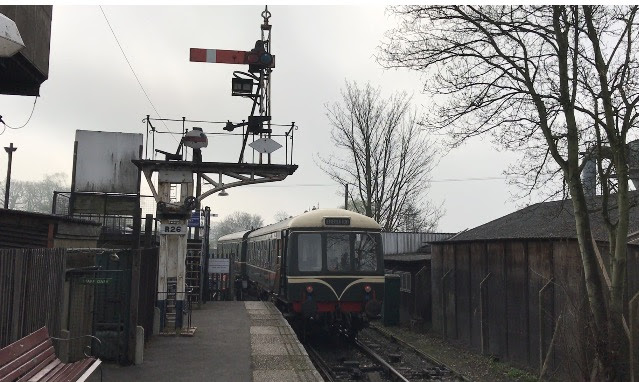
Started with a visit to Rolvenden station , as we arrived we was met by the DMMU just getting ready to go to Tenterden Town .we then climb up the spectators platform to view some of the stock outside the repair shed at the station
This is the view from the platform, from here you can see some of the rolling stock . in the picture is the the back of the Norwegian , and the Ford BTH BO BO ELECTRIC Featured on the video below.
Also from the platform we got a cracking view of the undercarriage of the 4253 , amazing job being done there. by all involved .
Its easy to take for granted the awesome endeavors of 19th Century railway pioneers which thread us through, around or over the nation's natural barriers. It was an age of speculative adventure, built on innovation, will power and elbow grease.
But many magnificent creations were abandoned during the industrial vandalism of the Fifties and Sixties.
today armed with my go pro
and my cannon
we capture these forgotten,abandoned and disused relics
This machine is an early 1960’s Plasser & Theurer VKR 05-E tamper DX74108. Apparently the tamping tines should vibrate with the ideal frequency of exactly 35 Hz. This directional, linear vibration combined with the non-synchronous tine movement produces a homogeneously compacted ballast
The Rother Valley Railway, a preservation group set up in 1991
And by March 2009 they had laid track from Bodiam to within 200 yards (180 m) of the site of Junction Road Halt at a cost of £200,000.
Track was relaid through the site of the halt in June 2010. On 18 March 2011, a VIP dining special was the first passenger train to traverse the rebuilt line. The following weekend of 19/20 March saw Kent and East Sussex Railway services run as far as Junction Road Now planning is agree , take a look at the next stages
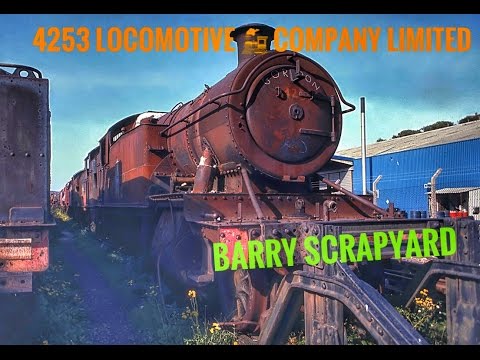
This locomotive, was built at Swindon in 1926 and spent its working life in and around Cardiff Valley hauling both freight and passenger trains. Like many others, 5668 ended up sold to Woodham’s scrap yard at Barry in November 1964 as steam was phased out in favour of diesel.
It languished there, slowly losing parts, until rescued and moved to the Pontypool & Blaenavon Railway in 1987.
Towards the end of 2012 The kent and East Sussex Railway offered this locomotive as part of a package deal involving a substantial quantity of parts that were required to progress the restoration of 4253. The agreement was that The 4253 Locomotive Company Limited would undertake the restoration of 5668 but that no work would commence until such time as 4253 had been completed and returned to steam.
Derelict carriages on the Kent & East Sussex Railway
One of the endearing features of most preserved railways is the various coaches and wagons to be seen from the train, not always at a station. Inevitably they are in various states of repair. These ones have some way to go.
This view is from a Tenterden-bound train on the Kent & East Sussex Railway, and these coaches are at the side of the line at Northiam.
This locomotive, was built at Swindon in 1926 and spent its working life in and around Cardiff Valley hauling both freight and passenger trains. Like many others, 5668 ended up sold to Woodham’s scrap yard at Barry in November 1964 as steam was phased out in favour of diesel. It languished there, slowly losing parts, until rescued and moved to the Pontypool & Blaenavon Railway in 1987. A very similar story to that of GWR 4253.
Towards the end of 2012
The kent and East Sussex Railway offered this locomotive as part of a package deal involving a substantial quantity of parts that were required to progress the restoration of 4253.
The agreement was that The 4253 Locomotive Company Limited would undertake the restoration of 5668 but that no work would commence until such time as 4253 had been completed and returned to steam.
At the 2013 AGM, shareholders voted in favour of proceeding with the deal and suggested an appeal be launched to raise funds to pay for the transportation of the loco from Blaenavon to Rolvenden. In excess of £2.6k was raised and, in late 2013, 5668 was moved to its new home.
Although no restoration work will begin for some years, it is important that the loco does not deteriorate
5668 was moved to Rolvenden yard where it was cleaned up and greased as necessary to provide some protection.
It has now been carefully sheeted and returned to Wittersham Road siding for storage to await its turn to be bought back to life.
As a result of this deal our railway, the Kent & East Sussex, will be assured that yet another powerful steam locomotive will be added to its fleet in due course to haul passenger trains on the extended line from Tenterden to Robertsbridge
In 1931 the Ford Motor Company ordered from the British Thompson Houston Company (BTH) three diesel-electric shunting locomotives for use at their new car plant at Dagenham in Essex. They were intended for hauling hot metal and slag ladles and to carry out general shunting operations between the Company's jetty on the River Thames and the Tilbury main line, a distance of about one mile. Since they were required to work across the main line to the Company's sidings on the north side, they were built to the LMS loading gauge. These locomotives owed something to an American ‘switcher' design which first appeared on the Central Railroad of New Jersey in 1925 and which were used at Fords American plant.
At the time of building they were
unique in Britain and created considerable interest at home and abroad. Locomotive frames and bodies, of all steel construction, were produced at the Sheffield works of the Metropolitan Vickers Electrical Co. Ltd. The engines, manufactured by W. H. Allen Sons & Co. Ltd of Bedford, were supplied to the BTH works at Rugby. The original specifications noted that the locomotives would have a weight of 44 tons and be provided with one 150 hp engine, coupled to a generator powering four traction motors, one to each axle. American fixed-pattern buckeye couplers were fitted. The locomotives were also fitted with sanding equipment, automatic bell, air whistles and a ‘dead-man's' handle to the driver's master controller. Driving cabs were provided at each end with an open platform for the shunter to ride on in safety. Finally, the specification stated "all materials will be of British manufacture..." Upon completion in 1932 the locomotives were turned out with Oxford blue bodies, gold lining round battery box covers and windows, dark grey roofs and black platforms, underframes and bogies.
The locomotives worked for 34 years at Dagenham, during which time each one is estimated to have run well in excess of 250,000 hours. Maintenance staff expected them to run without any major failures between annual overhauls. Just after world war 2 the diesel power units were stripped down, for the only time, for rebuild and it was found that less than 0.005 inches had to be removed from the crankshaft journals to restore them to true.
Ford No. 1 was acquired for the K&ESR in 1966 through the generosity of AEI Ltd (successors to BTH) but fitted with the engine from No. 2 which had been previously been cannibalised for spares. Arrival at Tenterden was on 7th July 1966, the locomotive being in green livery and having still been in use by Ford just two days previously.
After arrival, the buckeye couplings were replaced with screw couplings. In 1967 No. 40 (at first numbered 16) earned its keep on hire to work the mill siding at Robertsbridge. In February 1972 it hauled the last train from Robertsbridge to Bodiam prior to the dismantling of that section.
From 1976 the locomotive was the subject of an exhaustive rebuilding. Much of the bodywork was replaced, the generator completely overhauled by a contractor and all electrical components renovated or replaced. A vacuum exhauster was installed and the existing air brake pipework either replaced or adapted to allow the locomotive air brake to work in conjunction with the train vacuum brake. The fan and the cooling radiator were also overhauled. Refurbishment of the bogies and traction motors together with re-profiling of the wheel sets, was completed in 1983.
No. 40 was re-commissioned during 1986. It saw occasional service on passenger trains between Wittersham Road and Hexden bridge during times of high fire risk, but more usually worked permanent way works trains or as yard pilot at Tenterden. It was now again turned out in the Oxford blue livery also appropriate for the K&ESR. Following derailment during work on the extension to Northiam, suspicion fell on the locomotive's springing. No. 40 was accordingly laid aside during 1989. It was returned to operating condition in 2000 but is only used on special occasions because of its great age & operational limitation.
It was of 3 ft (914 mm) narrow gauge, relatively unusual amongst British narrow gauge railways. It operated from 1895 until 1939, connecting Rye to the coast. It was about 13⁄4 miles (2.8 km) in length, and had three stations - Rye, Golf Links and Camber Sands. It operated mainly to transport golfers to the golf links and holidaymakers to the coastal dunes.
3⁄4 miles (2.8 km) in length, and had three stations - Rye, Golf Links and Camber Sands. It operated mainly to transport golfers to the golf links and holidaymakers to the coastal dunes. The railway was constructed between January and July 1895 and ran entirely on private land. It was the first designed by consulting engineer Colonel Holman F. Stephens, who went on to build and run small railways all over the Country.
The line was built to convey golfers to the Rye Golf Club and ran from Rye station to the golf club. In 1908 the first extension to Camber Sands station was opened and the intermediate station renamed "Golf Links". Camber terminal was moved to a more accessible site and a tea hut was opened at the end of summer 1938, but this only used for a few months as the war intervened the next year.
Although initially quite successful, increasing competition from automobile and bus transport eventually caused the tramway to enter a gradual economic decline, as was the case with many small railways. Passenger service was ended at the outbreak of World War II but it was extensively used by the Government to convey parts for the P.L.U.T.O. (Pipe Line Under The Ocean) project for which a special siding leading to a new pier near Golf Links Station was constructed by Canadian troops.
The line was in such a run-down a condition by the end of the war that it was deemed irrecoverable and was sold for scrap in 1947. The Rye & Camber Tramways Co. Ltd was liquidated in February 1949. Remains A number of relics, including the frame and bogies of one of the carriages, can be seen at the Colonel Stephens Museum at Tenterden. Golf Links station building survives virtually intact. Some track is embedded in concrete near the station as the trackbed was used as a roadway during wartime. Most of the route is a footpath, although a short section has been destroyed by gravel workings. The line plays a prominent part in several novels by Rye resident E.F. Benson.
Built for the United States Army Corps of Engineers as No 1968, and sent to the UK under Lend-Lease. Stored at Newbury Racecourse. One of fourteen purchased by the Southern Railway and sent to the Melbourne Military Railway for running in. Entered service with the Southern Railway in November 1947 as USA Class number 65. Renumbered 30065 by British Railways. Worked at Southampton Docks. Withdrawn, and entered Departmental service as DS237 at Ashford Wagon Works. Withdrawn in April 1967 and sold to Woodham Brothers, Barry, Wales in March 1968. Developed a hot box en route and dumped at Tonbridge. Sold to K&ESR in August 1968 and delivered the next month. arriving at Rolvenden a month later became DS 237 No. 22.
No. 22 was the first large locomotive in service in 1974, proving itself very capable of hauling five coach trains up Tenterden bank. She was fitted with an extended bunker and a improved lubrication to overcome its bearing problems. In 1978 it exchanged boilers with No. 21 and after overhaul re-entered service in April 1981 in black livery lined out in red. Various mechanical problems occurred and were overcome before the boiler certificate again expired and the locomotive was taken out of traffic at the end of the 1990 season. Another extensive overhaul followed, the locomotive re-entering service as Southern Railway No. 65 in the summer of 1997. Its original post-war livery of black with sunshine lettering was now carried. However by 2002 a new firebox was required. This was fitted and a further overhaul undertaken the engine returning to service in 2008. has been withdraw service on 1st January 2017 when its boiler certificate expired
had by March 2009 laid track from Bodiam to within 200 yards (180 m) of the site of Junction Road Haltat a cost of £200,000 .
Track was relaid through the site of the halt in June 2010. On 18 March 2011, a VIP dining special was the first passenger train to traverse the rebuilt line. The following weekend of 19/20 March saw Kent and East Sussex Railway services run as far as Junction Road
The K&ESR owned two Terriers, the first bought in May 1901 and the second in February 1905, becoming No.3 “Bodiam” and No.5 “Rolvenden” respectively. Both were from the initial batch of six engines, four of which eventually came to Stephens’ railways. “Rolvenden”, the former LB&SCR No.71, had the honour of being the first Terrier built. “Bodiam”, although having the first number of the batch as LB&SCR No.70, was actually the last, having bequeathed her cylinders to 71, when a faulty casting had delayed her introduction into service (strange how these sisters were twinned from birth).
from the framemeplease collection
Both engines were painted in Stephens’ favourite blue livery with red lining, but without a polished dome. With regular overhauls, including that of “Bodiam” at Eastleigh in 1919 and “Rolvenden” at Brighton in 1917, they gave excellent service until the depression years.
from the framemeplease collection
They were alike as two peas for much of their lives together even to the near simultaneous acquisition of three rail coal bunker extensions (the LB&SCR extensions had four); the only difference being a long-strapped A1X type door carried by “Rolvenden”, probably acquired at Brighton. Although the two Ilfracombe Goods engines acquired in 1910 and 1914 became the favoured engines, the Terriers were the mainstay of the line in the Edwardian era, and much used thereafter.
Both engines seem to have received their last partial re-tube in late 1928, with “Bodiam” falling into disuse around the time of the railway’s receivership in 1931. (There is photographic evidence of her apparently in steam questionably dated as 12th September in that year.) “Rolvenden” seems to have lasted a little longer. They were then dumped in the works yard but “Bodiam” was resurrected in 1933 and repaired over the next two years, mainly by a Southern Railway fitter at weekends. Although much reported, there is little evidence, apart from anecdotal, to suggest that she incorporated many major parts from her sister, except possibly her tanks.
However some Terrier parts most certainly came from the Shropshire & Montgomery Terriers mentioned below. In the process “Bodiam” acquired her enlarged and distinctive bunker. Re-entering service on 27th December 1934, she was repainted in a bright apple green with yellow lining and, according to Austen’s usual practice, lost her nameplate becoming simply No.3, with the company’s initials appearing on the tank side above the number. Officially withdrawn in 1937, the hulk of “Rolvenden” was finally disposed of by T W Ward in October 1938.
from the framemeplease collection
“Bodiam” was replaced by a hired Terrier when its boiler gave out in September 1940. She was out of use until repaired in February 1943 with an A1X pattern boiler and smokebox. She may also have been fitted at this time with the S&MR’s Dido’s tanks acquired in 1941 (see below). Re-boilering was a difficult job for Rolvenden Works, so two K&ESR fitters undertook the work at St Leonards Shed under wartime’s cooperative arrangements. Finished in April 1943 the engine became to all intents and purposes an A1X, whilst retaining the sandboxes on the front splasher like some earlier Isle of Wight rebuilds. Some reports suggest that she did not return home until 7th March 18944 but this cannot now be verified. Further repairs were carried out at Brighton Works in September 1947 where she was repainted a darker green. After Nationalisation, the
engine was taken into British Railways’ stock and further repaired at Ashford in the second half of 1949; remarkably she was repainted again in apple green with yellow ling but as British Railways No.32670.
From then on she worked on the K&ESR until dieselisation; then working at Newhaven and elsewhere [including Hayling Island] with occasional returns including the last day special. She returned in 1964, to preservation – a true living embodiment of the continuity of the K&ESR – on whose metals she has been present for all but 9 of its 105 years of operation.
Thanks to Colonel Stephens Archives at the Kent and East Sussex Railway