11 May 2017 and Foxy becomes "The Cornish Riviera Express " on The Kent and East Sussex Railway
The Cornish Riviera Express is a express passenger train that has run between London Paddington and Penzance in Cornwall since 1904. Introduced by the Great Western Railway, the name Cornish Riviera Express has been applied to the late morning express train from London to Penzance continuously through nationalisation under British Rail and privatisation under First Great Western, only ceasing briefly during the two World Wars. The name is also applied to the late morning express train running in the opposite direction from Penzance to London. Through performance and publicity the Cornish Riviera Express has become one of the most famous named trains in the United Kingdom and is particularly renowned for the publicity employed by the Great Western Railway in the 1930s which elevated it to iconic status.
Today it is operated by Great Western Railway (train operating company).
The Great Western Railway steam locomotive no. 7822 Foxcote Manor is a 4-6-0 Manor Class locomotive, built in 1950 at Swindon Works. It is part of a post-war batch of 10 locomotives, which follows on from 20 earlier locomotives built in 1938.
FOXCOTE MANOR STEAMING OUT OF TENTERDEN
The locomotive was originally allocated to Oswestry depot, where it was used to haul both passenger and freight services over lines such as the Cambrian Line and the now-closed Ruabon Barmouth Line. It regularly hauled the "Cambrian Coast Express" from Shrewsbury to Aberystwyth. It was also allocated to Chester shed during its lifespan.
It was withdrawn in 1965 from Shrewsbury and was towed to Woodham Brothers scrapyard in Barry, South Wales.It languished there until 1974 when it was rescued for preservation. It was initially taken to Oswestry for restoration work, but is now based on the Llangollen Railway, a restored part of the Ruabon Barmouth Line, and it has seen regular services on the Llangollen Railway and has been on loan to the West Somerset Railway, Gloucestershire & Warwickshire Railway, South Devon Railway, Keighley and Worth Valley Railway, Great Central Railway (Nottingham) and even The North Yorkshire Moors Railway.
7822 returned to service in early 2016 following heavy boiler repairs and can be seen regularly operating at Llangollen.
Pensioners Treat, an opportunity for those aged 60 & over to travel at specially discounted fares. Travel by steam train through the picturesque countryside with the Kent & East Sussex Railway and if you are aged 60 or over take advantage of the special price of £13. Travel Card which allows all day travel. Adult Travel Cards are normally £18.
Everyone travelling on the railway can enjoy a relaxing steam train ride in beautifully restored carriages as the train takes passengers on a 21 mile return journey through Tenterden, Northiam and Bodiam stations. The return journey from Tenterden to Bodiam takes around 1 hour 45 minutes.
Visitors can choose to pre-order a delicious cream tea or ploughman’s lunch to enjoy during the trip and if grandchildren come along there is a children’s munch box option available. There will also be a warm welcome for visitors choosing to dine in the railway’s licensed restaurant at Tenterden station where you will find a choice of daily specials and a children’s menu.
Tenterden station is a short walk from the idyllic high street in Tenterden with its beautiful Georgian and Victorian buildings which is home to attractive boutiques, quaint antique shops and attractive cafes and restaurants.
At Bodiam station passengers can choose to take the short walk to Bodiam Castle and explore the romantic ruins, moat and impressive ramparts with their breathtaking views across the surrounding countryside.
For those who love to picnic, the railway offers an alfresco lunch option and pre-ordered picnic hamper can be ready to collect when you arrive at Tenterden station complete with napkins, cutlery and condiments.
The railway’s facilities have been carefully designed with disabled, elderly and less mobile visitors in mind. There are parking spaces for Blue Badge holders next to the platform at Tenterden Town and Northiam stations, and accessible toilets at Tenterden, Northiam and Bodiam stations. The railway has a specially designed coach for wheelchair users called ‘Petros’ which is fitted with ramped access, wide aisles, an accessible toilet and moveable seating. There is full wheelchair access to the shop and restaurant at Tenterden Town, and the Colonel Stephens Railway Museum has level access with 42” space aisles.
When at Tenterden Station why not visit the Colonel Stephens Railway Museum? Colonel Holman Fred Stephens was an English eccentric, a brilliant railway engineer, and the man who built the Kent & East Sussex Railway (and amazingly 16 other light railways). His legacy is commemorated in the award-winning museum next to Tenterden Town Station. Open every afternoon when trains are running and entry is FREE with your ticket
Well-behaved dogs on leads can travel on the railway for £3 on normal operating days (excluding Day Out With Thomas and Santa Special event days). to book follow the link below to the Kent And East Sussex website https://goo.gl/uHHP7h
Dates for May
Thursday, 4May201710:30 AM -Tuesday, 9May201710:30 AM -Wednesday, 10May201710:30 AM -Thursday, 11May201710:30 AM -Tuesday, 16May201710:30 AM -Wednesday, 17May201710:30 AM -Thursday, 18May201710:30 AM -Wednesday, 24May201710:30 AM -Thursday, 25May201710:30 AM -
Locomotive No. 7822 "Foxcote Manor" first day of service on the Kent and East Sussex Railway
7822 - affectionately known as ‘Foxy’
The visit is - in part - sponsored by the Kent & East Sussex Railway Guest Engine Club, setup by volunteers 18 months ago to encourage the hire of guest engines to enhance the railway’s home fleet when possible.
DISCLAIMER - Every effort will be made to provide the advertised services but unforseen circumstances may entail alterations and cancellations at short notice.
The locomotive was originally allocated to Oswestry depot, where it was used to haul both passenger and freight services over lines such as the Cambrian Line and the now-closed Ruabon Barmouth Line. It regularly hauled the "Cambrian Coast Express" from Shrewsbury to Aberystwyth. It was also allocated to Chester shed during its lifespan.
It was withdrawn in 1965 from Shrewsbury and was towed to Woodham Brothersscrapyard in Barry, South Wales.It languished there until 1974 when it was rescued for preservation. It was initially taken to Oswestry for restoration work, but is now based on the Llangollen Railway, a restored part of the Ruabon Barmouth Line, and it has seen regular services on the Llangollen Railway and has been on loan to the West Somerset Railway, Gloucestershire & Warwickshire Railway, South Devon Railway, Keighley and Worth Valley Railway, Great Central Railway (Nottingham) and even The North Yorkshire Moors Railway. 7822 returned to service in early 2016 following heavy boiler repairs and can be seen regularly operating at Llangollen.
The locomotive was originally allocated to Oswestry depot, where it was used to haul both passenger and freight services over lines such as the Cambrian Line and the now-closed Ruabon Barmouth Line. It regularly hauled the "Cambrian Coast Express" from Shrewsbury to Aberystwyth. It was also allocated to Chester shed during its lifespan.
It was withdrawn in 1965 from Shrewsbury and was towed to Woodham Brothersscrapyard in Barry, South Wales.It languished there until 1974 when it was rescued for preservation. It was initially taken to Oswestry for restoration work, but is now based on the Llangollen Railway, a restored part of the Ruabon Barmouth Line, and it has seen regular services on the Llangollen Railway and has been on loan to the West Somerset Railway, Gloucestershire & Warwickshire Railway, South Devon Railway, Keighley and Worth Valley Railway, Great Central Railway (Nottingham) and even The North Yorkshire Moors Railway.
7822 returned to service in early 2016 following heavy boiler repairs and can be seen regularly operating at Llangollen.
railway signalling, a token is a physical object which a locomotive driver is required to have or see before entering onto a particular section of single track. The token is clearly endorsed with the names of the section it belongs to. A token system is used for single lines because of the very much greater risk of serious collision in the event of irregular working by signalmen or traincrews, than on double lines.
The operation of a bidirectional single track line has obvious problems, the most serious of which is the possibility of two trains traversing the line travelling towards each other, each driver unaware that the other is using the line. The simplest method of controlling such a line is to have only one engine operational, on the basis that a single train cannot collide with itself .
EditThe token system was developed in Britain in the 19th century, to facilitate safe working of single-line railways. If a branch line is a dead end with a simple shuttle train service, then a single token is sufficient. The driver of any train entering the branch line (or occupying any part of it) must be in possession of the token, and no collision with another train is possible.
Using only a single token does not provide convenient operation when consecutive trains are to be worked in the same direction. The simple token system was therefore extended: if one train was to be followed by another in the same direction, the driver of the first train was required to be shown the token, but not take possession of it (in theory he was supposed to physically touch the token, but this was not strictly followed). He was given a written authority to enter the single line section, referred to as the ticket. He could then proceed, and a second train could follow. In the earliest days the second train could proceed after a designated time interval, as on double lines at the time. However, following the Armagh rail disaster of 1889, block working became mandatory.
Seeing the train staff provided assurance that there could be no head-on collision. To ensure that the ticket is not issued incorrectly, a book of numbered tickets is kept in a locked box, the key to which is permanently fastened to the token, or is the token. In addition, the lock prevents the token being removed until the ticket box is closed, and it cannot be closed unless the book of tickets is in the box. Once a ticket is issued, its number is recorded in a Train Register book, and the token is locked in a secure place. This system is known as staff and ticket.
In a variation on this principle, called divisible train staff, a section of the token referred to as the ticket portionwas designed to be removed and handed to the driver instead of a paper ticket.
Electric token
The staff and ticket system was still too inflexible for busy lines, as it did not allow for the situation where the train intended to carry the actual token was cancelled or running very late. To provide for this, the electric train token system was developed. Each single-line section is provided with a pair of token instruments, one at the signal box at each end. A supply of identical tokens is stored in the instruments, which are connected by telegraph lines. A token can be removed from one instrument only if both signalmen co-operate in agreeing to the release. Once a token has been removed, another cannot be removed until the token which is "out" is replaced in either instrument. (There are variations on this sequence of events.) By this means, it can be ensured that at any one time, only one token is available to be issued to a driver. Tokens belonging to adjacent sections have different configurations to prevent them being inserted into the wrong instrument.
Nevertheless, in the Abermule train collision in 1921, lax working procedures allowed the safeguards provided by the electric token system to be circumvented; a driver was handed a token for the wrong section, and proceeded on the mistaken belief that the token was correct. To prevent this, it became a requirement in the UK for the signals controlling entry to the single line section (starting or section signals) to be locked at danger unless a token has been released from the relevant token instrument.
No. 19 Norwegian NORWEGIAN STATE RAILWAY 21C CLASS 2-6-0 TENDER LOCOMOTIVE on the kent and East Sussex Railway
The only tender locomotive on the K&ESR, No. 19 arrived in 1971 having been purchased privately and transported from Oslo.
No. 19 was built for the Norwegian State Railway (NSB) by the Swedish firm of Nydquist and Holm (works No. 1163) at Trollhattan in 1919. Eight such locomotives were constructed and designated class 21c. They developed from an earlier series of 2-6-0 moguls built for the NSB. The first three had been built by Messrs Dubs and Company of Glasgow in 1891, the design being credited to David Jones of the Highland Railway. There is also one preserved in Norway and another (No. 377) in this country.
Given the running number 376, this locomotive and its sisters were built for use on the Kongsvingar line in south eastern Norway. Displaced from there, No. 376 ended its days as motive power for snow plough work at Grong on the Nordland line, some 60 miles north of Trondheim. An interesting feature of the 38 ton locomotive was the enclosed cab fitted to provide shelter during the long hours of darkness encountered in the north of Norway. A headlamp is also fitted above the smokebox door, current being provided by a steam generator mounted above the firebox.
After arrival on the K&ESR it was fitted with a vacuum brake and retubed whilst retaining the airbrake for its own use. As K&ESR No. 19 it was regularly in service during 1974-76, but was withdrawn in 1977 for extensive overhaul and repairs.
Work proceeded only slowly and the locomotive changed hands several times. During 1984 it came into the ownership of the Norwegian Locomotive Trust. The tender had to be virtually rebuilt as the old one had suffered bad wastage and it was at this stage that the tender portion of the fully-enclosed cab was dispensed with. As far as the boiler was concerned, many stays needed to be replaced as did all tubes and superheater elements and a new smokebox and ashpan were also required. A particularly time consuming aspect of the overhaul was the valve gear which was very badly worn. The locomotive re-entered traffic in 1996 and was ceremoniously recommissioned by His Excellency the Norwegian Ambassador, the Patron of the Trust. Shortly afterwards the locomotive was named Norwegian.
The Locomotive was withdrawn for routine overhaul but returned to service in summer 2013.
Magnettes & Steam Saturday 15 April 2017 at Kent and East Sussex Railway
For more than 20 years 'Magnettes and Steam' has been the traditional start to the MG Magnette events season. Vehicles were on display throughout the day at Tenterden Town Station
And there' was opportunity to talk with owners of these popular 1950's sports saloons. Entry was free to K&ESR ticket holders
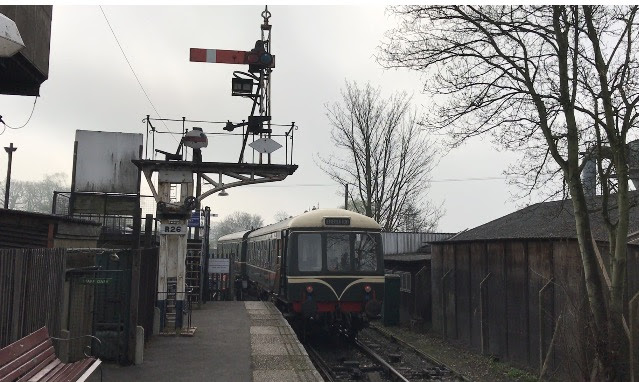
Started with a visit to Rolvenden station , as we arrived we was met by the DMMU just getting ready to go to Tenterden Town .we then climb up the spectators platform to view some of the stock outside the repair shed at the station
This is the view from the platform, from here you can see some of the rolling stock . in the picture is the the back of the Norwegian , and the Ford BTH BO BO ELECTRIC Featured on the video below.
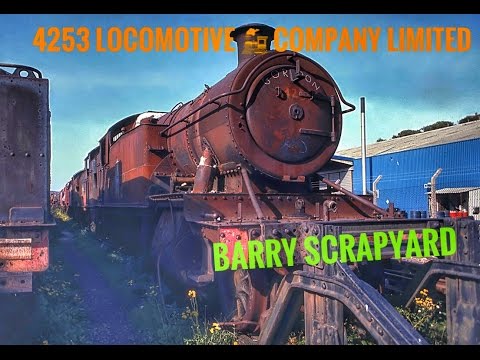
Also from the platform we got a cracking view of the undercarriage of the 4253 , amazing job being done there. by all involved .
A little known lost railway in Sussex is the former Rye and Camber Tramway, which operated for 44 years as a passenger service from 1895 until the outbreak of World War II. At that point the railway passed into military hands for use with the PLUTO project designed to supply the front line troops for the D Day landings.
this video tells you all
Sadly the state it was returned to the owners in meant that it was no longer in a fit state to carry passengers and it was therefore closed for good as the cost of renewing the track was prohibitive. Yet, at its height this remarkable railway carried as many as 18000 passengers during a six month period. Designed and built by the famous light railway builder Colonel Holman Stephens, the railway ran for about three miles from the eastern edge of Rye to a rather inconvenient location at the western edge of Camber. It was intended to carry passengers to the seaside, but also to a nearby golf club for which an intermediate station was built.
As with many Colonel Stephens’ railways, the line was built on a shoestring and this rather contributed to its untimely end.It also meant that once gone, few reminders of its existence still remain.Yet, remarkably despite all this most of the trackbed is still available for walking.
so if you need a little Sunday walk i recommend it