Kent and East Sussex Railway and Rother Valley Railway Extension to Udiam Farm from Bodiam
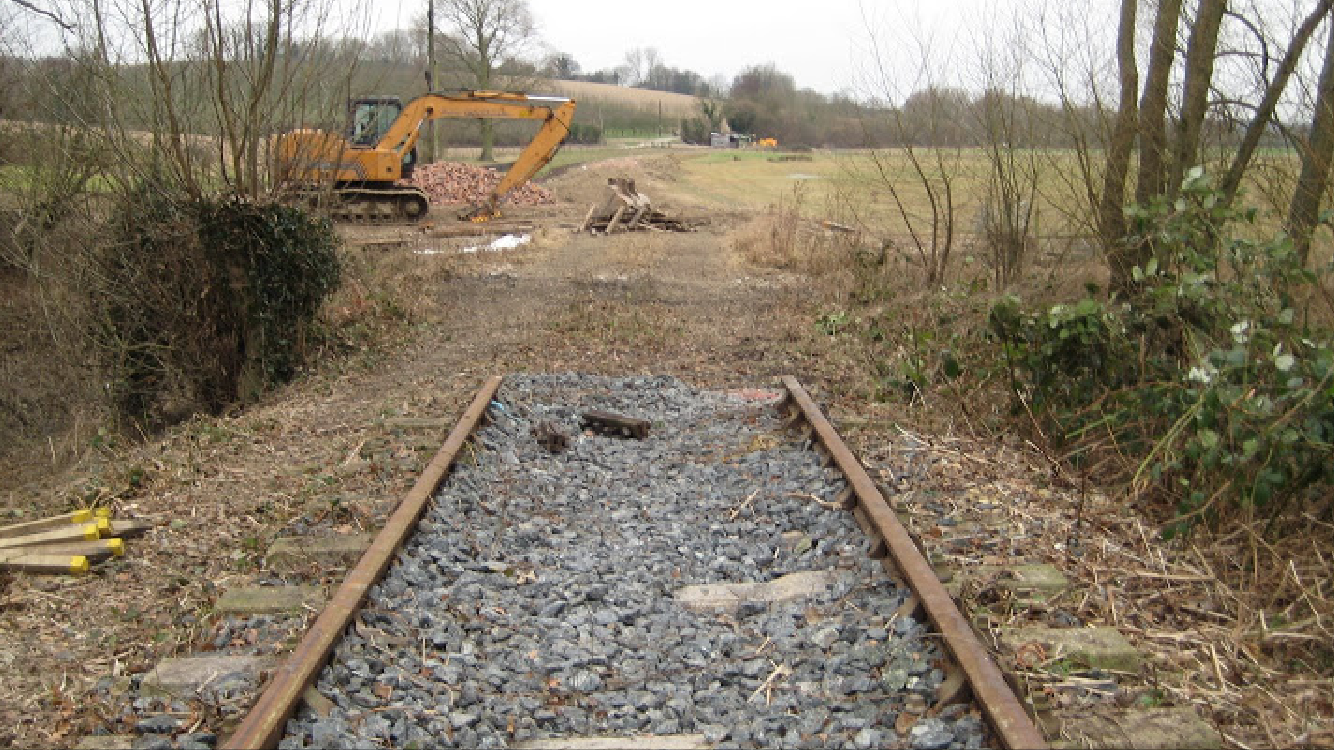
The Rother Valley Railway, a preservation group set up in 1991, had by March 2009 laid track from Bodiam to within 200 yards (180 m) of the site of Junction Road Halt at a cost of £200,000.
Track was relaid through the site of the halt in June 2010.
On 18 March 2011, a VIP dining special was the first passenger train to traverse the rebuilt line.
The following weekend of 19/20 March saw Kent and East Sussex Railway services run as far as Junction Road
Built for the United States Army Corps of Engineers as No 1968, and sent to the UK under Lend-Lease. Stored at Newbury Racecourse. One of fourteen purchased by the Southern Railway and sent to the Melbourne Military Railway for running in. Entered service with the Southern Railway in November 1947 as USA Class number 65. Renumbered 30065 by British Railways. Worked at Southampton Docks. Withdrawn, and entered Departmental service as DS237 at Ashford Wagon Works. Withdrawn in April 1967 and sold to Woodham Brothers, Barry, Wales in March 1968. Developed a hot box en route and dumped at Tonbridge. Sold to K&ESR in August 1968 and delivered the next month. arriving at Rolvenden a month later became DS 237 No. 22.
No. 22 was the first large locomotive in service in 1974, proving itself very capable of hauling five coach trains up Tenterden bank. She was fitted with an extended bunker and a improved lubrication to overcome its bearing problems. In 1978 it exchanged boilers with No. 21 and after overhaul re-entered service in April 1981 in black livery lined out in red. Various mechanical problems occurred and were overcome before the boiler certificate again expired and the locomotive was taken out of traffic at the end of the 1990 season. Another extensive overhaul followed, the locomotive re-entering service as Southern Railway No. 65 in the summer of 1997. Its original post-war livery of black with sunshine lettering was now carried. However by 2002 a new firebox was required. This was fitted and a further overhaul undertaken the engine returning to service in 2008. has been withdraw service on 1st January 2017 when its boiler certificate expired
had by March 2009 laid track from Bodiam to within 200 yards (180 m) of the site of Junction Road Haltat a cost of £200,000 .
Track was relaid through the site of the halt in June 2010. On 18 March 2011, a VIP dining special was the first passenger train to traverse the rebuilt line. The following weekend of 19/20 March saw Kent and East Sussex Railway services run as far as Junction Road
The K&ESR owned two Terriers, the first bought in May 1901 and the second in February 1905, becoming No.3 “Bodiam” and No.5 “Rolvenden” respectively. Both were from the initial batch of six engines, four of which eventually came to Stephens’ railways. “Rolvenden”, the former LB&SCR No.71, had the honour of being the first Terrier built. “Bodiam”, although having the first number of the batch as LB&SCR No.70, was actually the last, having bequeathed her cylinders to 71, when a faulty casting had delayed her introduction into service (strange how these sisters were twinned from birth).
from the framemeplease collection
Both engines were painted in Stephens’ favourite blue livery with red lining, but without a polished dome. With regular overhauls, including that of “Bodiam” at Eastleigh in 1919 and “Rolvenden” at Brighton in 1917, they gave excellent service until the depression years.
from the framemeplease collection
They were alike as two peas for much of their lives together even to the near simultaneous acquisition of three rail coal bunker extensions (the LB&SCR extensions had four); the only difference being a long-strapped A1X type door carried by “Rolvenden”, probably acquired at Brighton. Although the two Ilfracombe Goods engines acquired in 1910 and 1914 became the favoured engines, the Terriers were the mainstay of the line in the Edwardian era, and much used thereafter.
Both engines seem to have received their last partial re-tube in late 1928, with “Bodiam” falling into disuse around the time of the railway’s receivership in 1931. (There is photographic evidence of her apparently in steam questionably dated as 12th September in that year.) “Rolvenden” seems to have lasted a little longer. They were then dumped in the works yard but “Bodiam” was resurrected in 1933 and repaired over the next two years, mainly by a Southern Railway fitter at weekends. Although much reported, there is little evidence, apart from anecdotal, to suggest that she incorporated many major parts from her sister, except possibly her tanks.
However some Terrier parts most certainly came from the Shropshire & Montgomery Terriers mentioned below. In the process “Bodiam” acquired her enlarged and distinctive bunker. Re-entering service on 27th December 1934, she was repainted in a bright apple green with yellow lining and, according to Austen’s usual practice, lost her nameplate becoming simply No.3, with the company’s initials appearing on the tank side above the number. Officially withdrawn in 1937, the hulk of “Rolvenden” was finally disposed of by T W Ward in October 1938.
from the framemeplease collection
“Bodiam” was replaced by a hired Terrier when its boiler gave out in September 1940. She was out of use until repaired in February 1943 with an A1X pattern boiler and smokebox. She may also have been fitted at this time with the S&MR’s Dido’s tanks acquired in 1941 (see below). Re-boilering was a difficult job for Rolvenden Works, so two K&ESR fitters undertook the work at St Leonards Shed under wartime’s cooperative arrangements. Finished in April 1943 the engine became to all intents and purposes an A1X, whilst retaining the sandboxes on the front splasher like some earlier Isle of Wight rebuilds. Some reports suggest that she did not return home until 7th March 18944 but this cannot now be verified. Further repairs were carried out at Brighton Works in September 1947 where she was repainted a darker green. After Nationalisation, the
engine was taken into British Railways’ stock and further repaired at Ashford in the second half of 1949; remarkably she was repainted again in apple green with yellow ling but as British Railways No.32670.
From then on she worked on the K&ESR until dieselisation; then working at Newhaven and elsewhere [including Hayling Island] with occasional returns including the last day special. She returned in 1964, to preservation – a true living embodiment of the continuity of the K&ESR – on whose metals she has been present for all but 9 of its 105 years of operation.
Thanks to Colonel Stephens Archives at the Kent and East Sussex Railway
Perched on a hill, the medieval town of Rye is the sort of place you thought existed only in your imagination. Almost suspended in time, Rye’s unhurried atmosphere and enchanting streets draw visitors with their warm welcome. It’s small enough to make you feel at home almost straight away but holds enough secret treasures to entice you to stay much longer.
Even the sea is a little wayward at times The River Rother originally took an easterly course to flow into the sea near what is now New Romney. However, the violent storms in the 13th century (particularly in 1250 and 1287) cut the town off from the sea, destroyed Old Winchelsea and changed the course of the Rother. Then the sea and the river combined in about 1375 to destroy the eastern part of the town and ships began use the current area (the Strand) to unload their cargoes. Two years later the town was sacked and burnt by the French, and it was ordered that the town walls be completed,] as a defence against foreign raiders. it retreated from the town centuries ago, leaving Rye a stranded seaside town.
A visit to the Rother Valley Railway in February 2017
Nice to see the banana 🍌Wagons and the water Tank
The Toilet blocks are really taking shape . And the more I see of the construction work
To look not out of place.I can tell the amount of effort is going into this project
Many more obstacles lay a head . Let's hope they get there before nature takes over
Photo Framemeplease
Kent and East Sussex Railways . Disuesd Station Headcorn
Date opened:
15.5.1905
Location:
On the south side of the existing Headcorn Station
Company on opening:
Kent & East Sussex Railway
Date closed to passengers:
4.1.1954
Date closed completely:
4.1.1954
Company on closing:
British Railways (Southern Region)
Present state:
Unknown
County:
Kent
(Brief history of the Kent & East Sussex Railway)
The Rother Valley Railway was proposed in 1896 and was the first line to be built under the 1896 Light Railway Act that permitted lightly constructed lines to be built in rural areas. The line was engineered by Holman Stephens (later Colonel Stephens) who went on to build a number of light railways around the country. The first section between Robertsbridge and Tenterden (later renamed Rolvenden) opened on 2.4.1900. The line was extended to Tenterden Town in 1903 and Headcorn in 1905.
The line was renamed the Kent & East Sussex Railway was initially moderately profitable although the northern section was subsidised by the South Eastern & Chatham Railway. After WW1 there were heavy losses eventually leading to bankruptcy in 1931. The line had remained independent after the 1923 amalgamation and despite loss of revenue with many of its passengers switching to busses it continued to provide a valuable service, especially to the farming community, through the 1930's.
Shortly after final closure a preservation society was formed but it was a further 13 years before trains returned to the line, the main stumbling block being the large number of road crossings. Eventually a compromise was agreed once the Society agreed to drop the section of line between Bodiam and Robertsbridge from the restoration proposal. The Kent & East Sussex Railway Company became a registered charity and work progressed quickly with the first section of restored line opening at Tenterden on 3.2.1974; this was extended to Wittisham Road in 1977, Northiam in 1990 and Bodiam in 2000.
Following a decline in passenger and freight traffic, the KESR between Headcorn and Tenterden was closed to all traffic in 1954. Goods facilities were withdrawn from Headcorn in 1962, and the goods yard became a car park. The SER's original buildings however survived until 1988 when they were swept away by British Rail as part of a modernisation scheme
St Michaels Tunnel the forgotten relic of the Kent and East Sussex Railway
Add caption
One of his 'bigger' feats was St Michaels Tunnel, located just north of the halt. Opened in 1905 as part of an extension from Tenterden to Headcorn, it is just 31 yards in length and curves to the east on a radius of approximately 30 chains.The portals are neat, brick-built affairs with a masonry string course and copings. Wing walls extend outwards parallel to the track - the east-side wall at the south end is cracked top to bottom. Horseshoe shaped in profile, the lining comprises four rings of brick and features a single refuge. Timber brackets supported telegraph wires.
now a back garden
Despite almost 60 years of redundancy, the structure remains in fair condition except for the cracked wing wall and some spalling of the north portal's headwall. The interior has found function as a wood store, used by the householder whose property it stands on. a train running through the tunnel
Razed to the ground after complete closure by British Railways in 1961, this station has risen from the ashes under the auspices of the preserved ‘’Kent & East Sussex Railway’’ (K&ESR). Wittersham Road originally came into passenger use with the ‘’Rother Valley Railway’’ (RVR) between Robertsbridge and Tenterden on 2nd April 1900, goods traffic having commenced on 29th of the previous month. As mentioned elsewhere on the website, the line was subject to a 1⅓-mile eastward extension to a more conveniently-sited ‘’Tenterden Town’’ station, and was eventually taken as far as Headcorn, where it met the ex-SER Dover trunk line. These extensions came into use on 16th March 1903 and 15th May 1905 respectively, and the RVR became known as the K&ESR from 1904 onwards.
The line was engineered by Holman F. Stephens, and architecture was standardised along the route, a practice which had been followed by numerous of the larger railway companies nationwide. The route was single-track throughout, and in common with most stations on the line, just a single brick-built platform surface was provided at Wittersham Road. The station resided 2¼-miles northwest of the village it purported to serve, hence its ‘’Road’’ suffix, and its construction certainly seemed reminiscent of the old SER policy of providing stations at a ‘’modest cost’’! Wittersham Road’s main building was a typical unassuming H.F. Stephens affair: single-storey, it was fully fabricated from corrugated iron – as per all those structures in-between Robertsbridge and Tenterden Town exclusive – and incorporated sash-style windows. The fact that the building was erected at right angles to the platform seems to explain why it was the only station structure along the entire route to lack a canopy. The very same style of construction could be found on H.F. Stephens’ contemporary Sheppey Light Railway in North Kent, and on those railways he engineered in far flung locations in Shropshire and Wales.
Wittersham Road’s platform was lined at its rear by wire fencing, which in turn was accompanied by rectangular-shaped gas lamps supported upon wooden posts. Behind the platform could be found the station’s goods facilities, which comprised a pair of Tenterden-facing sidings, access to which was controlled from a lever frame positioned north east of the layout. Signalling at the site was primitive, simply comprising a double-armed semaphore post at the Robertsbridge end of the station platform, which resided immediately adjacent to a level crossing. The latter was protected by a pair of timber gates, to which were affixed a red warning diamond, as opposed to the more customary circle. This was not unique to Wittersham Road, a number of other level crossings along the route being similarly treated. It is worth noting that the station lacked a loop, thus it was not possible for trains to pass in the station (unless, in an extreme case, a train service was stabled in the goods yard to let another pass!).
Naturally, the station led a quiet existence on a decidedly rural route, but the monotony was broken as a result of World War II. In February 1941, the goods yard became host to a 32-ton rail-mounted gun, which could fire 9.2-inch diameter shells, and had a range of twenty miles. Thus, in the event of an invasion, the gun’s fire was able to hit the coastline of the Romney Marsh. The gun was not used in anger, although was test fired, and to move the colossus, an ex-GWR 0-6-0 ‘’Dean Goods’’ locomotive, now under ‘’War Department’’ ownership, was provided on the line. The locomotive was also used to move an identical gun based at Rolvenden. To accommodate the gun at Wittersham Road, an ammunition store was erected in the goods yard, as was a gun crew hut. A military presence remained at the station until August 1944.
RVR Rother Valley Railway Restoring the Missing link 2017 Rother Valley Railway KESR to RVR
The Rother Valley Railway (RVR) is a heritage railway project based at Robertsbridge in East Sussex, England. It takes its name from the original name for what later became the Kent and East Sussex Railway, running from Robertsbridge through to Headcorn in Kent, via Tenterden. The project is to replace the ‘missing link’ between Robertsbridge, a station on the Tonbridge to Hastings mainline, and Bodiam on the Kent and East Sussex Railway, a heritage railway which operates from Bodiam to Tenterden. A charity supported by a society of volunteers are attempting to re-establish the railway link. The RVR began by reinstating the first few hundred yards of line eastwards from Robertsbridge, and also a short stretch westwards from Bodiam. In 2010, the latter section was further extended to reach Junction Road. In summer 2011 work began at Robertsbridge to extend further eastwards to Northbridge Street, which entailed the rebuilding of five bridges. By June 2012, this further extension was also completed. In September 2013, a Gala weekend at Robertsbridge marked the progress to date and the start of the next phase - the re-instatement of the section between Northbridge Street and Junction Road, for which statutory permissions are being sought. While the RVR does not yet feature regular passenger trains, the base at Robertsbridge houses a small shop and visitor centre open to the public each Sunday, utilising a building formerly used as the London terminus of the Orient Express. There is also a small collection of historic railway vehicles in various stages of preservation.
Drone footage of RVR
Pictures by https://www.facebook.com/Frame-Me-Ple....
RVR website http://www.rvr.org.uk
KESR website http://www.kesr.org