PHOTO COURTESY OF framemeplease19.wixsite.com/trackbedwalker
The Great Western Railway steam locomotive no. 7822 Foxcote Manor is a 4-6-0 Manor Class locomotive, built in 1950 at Swindon Works. It is part of a post-war batch of 10 locomotives, which follows on from 20 earlier locomotives built in 1938.
7822 returned to service in early 2016 following heavy boiler repairs and can be seen regularly operating at Llangollen. 7822 was on hire to the Kent & East Sussex Railway throughout May 2017.
Here you see foxy steaming down Tenterden Bank
Here she is reaching English Heritage site Bodiam Castle
The locomotive was originally allocated to Oswestry depot, where it was used to haul both passenger and freight services over lines such as the Cambrian Line and the now-closed Ruabon Barmouth Line. It regularly hauled the "Cambrian Coast Express" from Shrewsbury to Aberystwyth. It was also allocated to Chester shed during its lifespan.
It was withdrawn in 1965 from Shrewsbury and was towed to Woodham Brothersscrapyard in Barry, South Wales.It languished there until 1974 when it was rescued for preservation. It was initially taken to Oswestry for restoration work, but is now based on the Llangollen Railway, a restored part of the Ruabon Barmouth Line, and it has seen regular services on the Llangollen Railway and has been on loan to the West Somerset Railway, Gloucestershire & Warwickshire Railway, South Devon Railway, Keighley and Worth Valley Railway, Great Central Railway (Nottingham) and even The North Yorkshire Moors Railway.
7822 returned to service in early 2016 following heavy boiler repairs and can be seen regularly operating at Llangollen.
The Rother Valley Railway, a preservation group set up in 1991
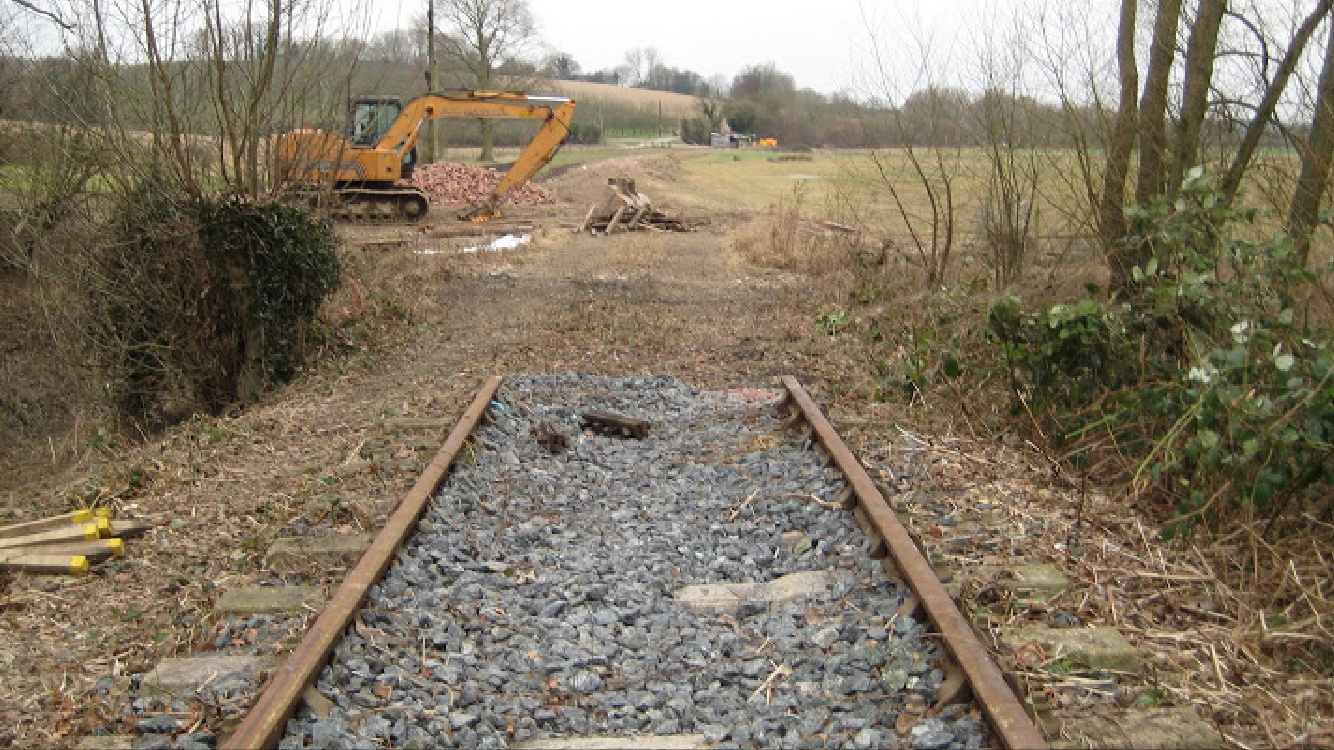
And by March 2009 they had laid track from Bodiam to within 200 yards (180 m) of the site of Junction Road Halt at a cost of £200,000.
Track was relaid through the site of the halt in June 2010. On 18 March 2011, a VIP dining special was the first passenger train to traverse the rebuilt line. The following weekend of 19/20 March saw Kent and East Sussex Railway services run as far as Junction Road Now planning is agree , take a look at the next stages
Derelict carriages on the Kent & East Sussex Railway
One of the endearing features of most preserved railways is the various coaches and wagons to be seen from the train, not always at a station. Inevitably they are in various states of repair. These ones have some way to go.
This view is from a Tenterden-bound train on the Kent & East Sussex Railway, and these coaches are at the side of the line at Northiam.
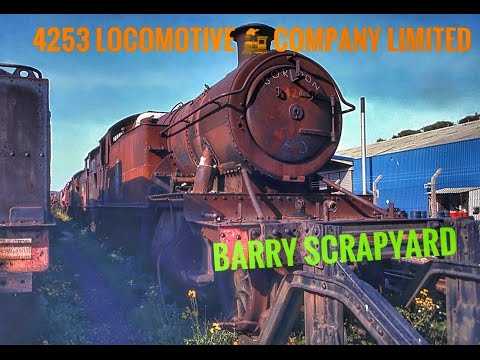
This locomotive, was built at Swindon in 1926 and spent its working life in and around Cardiff Valley hauling both freight and passenger trains. Like many others, 5668 ended up sold to Woodham’s scrap yard at Barry in November 1964 as steam was phased out in favour of diesel. It languished there, slowly losing parts, until rescued and moved to the Pontypool & Blaenavon Railway in 1987. A very similar story to that of GWR 4253.
Towards the end of 2012
The kent and East Sussex Railway offered this locomotive as part of a package deal involving a substantial quantity of parts that were required to progress the restoration of 4253.
The agreement was that The 4253 Locomotive Company Limited would undertake the restoration of 5668 but that no work would commence until such time as 4253 had been completed and returned to steam.
At the 2013 AGM, shareholders voted in favour of proceeding with the deal and suggested an appeal be launched to raise funds to pay for the transportation of the loco from Blaenavon to Rolvenden. In excess of £2.6k was raised and, in late 2013, 5668 was moved to its new home.
Although no restoration work will begin for some years, it is important that the loco does not deteriorate
5668 was moved to Rolvenden yard where it was cleaned up and greased as necessary to provide some protection.
It has now been carefully sheeted and returned to Wittersham Road siding for storage to await its turn to be bought back to life.
As a result of this deal our railway, the Kent & East Sussex, will be assured that yet another powerful steam locomotive will be added to its fleet in due course to haul passenger trains on the extended line from Tenterden to Robertsbridge
Kent and East Sussex Railway and Rother Valley Railway Extension to Udiam Farm from Bodiam
The Rother Valley Railway, a preservation group set up in 1991, had by March 2009 laid track from Bodiam to within 200 yards (180 m) of the site of Junction Road Halt at a cost of £200,000.
Track was relaid through the site of the halt in June 2010.
On 18 March 2011, a VIP dining special was the first passenger train to traverse the rebuilt line.
The following weekend of 19/20 March saw Kent and East Sussex Railway services run as far as Junction Road
The K&ESR owned two Terriers, the first bought in May 1901 and the second in February 1905, becoming No.3 “Bodiam” and No.5 “Rolvenden” respectively. Both were from the initial batch of six engines, four of which eventually came to Stephens’ railways. “Rolvenden”, the former LB&SCR No.71, had the honour of being the first Terrier built. “Bodiam”, although having the first number of the batch as LB&SCR No.70, was actually the last, having bequeathed her cylinders to 71, when a faulty casting had delayed her introduction into service (strange how these sisters were twinned from birth).
from the framemeplease collection
Both engines were painted in Stephens’ favourite blue livery with red lining, but without a polished dome. With regular overhauls, including that of “Bodiam” at Eastleigh in 1919 and “Rolvenden” at Brighton in 1917, they gave excellent service until the depression years.
from the framemeplease collection
They were alike as two peas for much of their lives together even to the near simultaneous acquisition of three rail coal bunker extensions (the LB&SCR extensions had four); the only difference being a long-strapped A1X type door carried by “Rolvenden”, probably acquired at Brighton. Although the two Ilfracombe Goods engines acquired in 1910 and 1914 became the favoured engines, the Terriers were the mainstay of the line in the Edwardian era, and much used thereafter.
Both engines seem to have received their last partial re-tube in late 1928, with “Bodiam” falling into disuse around the time of the railway’s receivership in 1931. (There is photographic evidence of her apparently in steam questionably dated as 12th September in that year.) “Rolvenden” seems to have lasted a little longer. They were then dumped in the works yard but “Bodiam” was resurrected in 1933 and repaired over the next two years, mainly by a Southern Railway fitter at weekends. Although much reported, there is little evidence, apart from anecdotal, to suggest that she incorporated many major parts from her sister, except possibly her tanks.
However some Terrier parts most certainly came from the Shropshire & Montgomery Terriers mentioned below. In the process “Bodiam” acquired her enlarged and distinctive bunker. Re-entering service on 27th December 1934, she was repainted in a bright apple green with yellow lining and, according to Austen’s usual practice, lost her nameplate becoming simply No.3, with the company’s initials appearing on the tank side above the number. Officially withdrawn in 1937, the hulk of “Rolvenden” was finally disposed of by T W Ward in October 1938.
from the framemeplease collection
“Bodiam” was replaced by a hired Terrier when its boiler gave out in September 1940. She was out of use until repaired in February 1943 with an A1X pattern boiler and smokebox. She may also have been fitted at this time with the S&MR’s Dido’s tanks acquired in 1941 (see below). Re-boilering was a difficult job for Rolvenden Works, so two K&ESR fitters undertook the work at St Leonards Shed under wartime’s cooperative arrangements. Finished in April 1943 the engine became to all intents and purposes an A1X, whilst retaining the sandboxes on the front splasher like some earlier Isle of Wight rebuilds. Some reports suggest that she did not return home until 7th March 18944 but this cannot now be verified. Further repairs were carried out at Brighton Works in September 1947 where she was repainted a darker green. After Nationalisation, the
engine was taken into British Railways’ stock and further repaired at Ashford in the second half of 1949; remarkably she was repainted again in apple green with yellow ling but as British Railways No.32670.
From then on she worked on the K&ESR until dieselisation; then working at Newhaven and elsewhere [including Hayling Island] with occasional returns including the last day special. She returned in 1964, to preservation – a true living embodiment of the continuity of the K&ESR – on whose metals she has been present for all but 9 of its 105 years of operation.
Thanks to Colonel Stephens Archives at the Kent and East Sussex Railway
Comprising a single platform and small corrugated hut, the modest halt at St Michaels was added to the Kent & East Sussex Light Railway in 1912 to serve a small community on the outskirts of Tenterden. Its ticket office - if you could call it that - closed in 1938 and the local infrastructure's decline continued until services were withdrawn on 4th January 1954.
The line was engineered and operated by Colonel H F Stephens. One of his 'bigger' feats was St Michaels Tunnel, located just north of the halt. Opened in 1905 as part of an extension from Tenterden to Headcorn, it is just 31 yards in length and curves to the east on a radius of approximately 30 chains.
The portals are neat, brick-built affairs with a masonry string course and copings. Wing walls extend outwards parallel to the track - the east-side wall at the south end is cracked top to bottom. Horseshoe shaped in profile, the lining comprises four rings of brick and features a single refuge. Timber brackets supported telegraph wires.
Despite 60 years of redundancy, the structure remains in fair condition except for the cracked wing wall and some spalling of the north portal's headwall. The interior has found function as a wood store, used by the householder whose property it stands on.
Situated half a mile from the Bodiam village itself and its fourteenth century castle, the station opened in 1900 in a rather remote and rural location.
It was surrounded by hop fields, mainly owned by Guinness, and helped to serve the industry in the area, bringing hop-pickers to and from the fields and transporting hops to the breweries. In 1910.
Add cap
A siding was added which effectively acted as a loop allowing freight trains to pass passenger trains. The station was known as "Bodiam for Staplecross".
In keeping with other stations on the line, the main station building was fitted out in typical spartan style. Only Gents toilet facilities were available and the urinal was flushed using water gathered in the building's rainwater pipe.
Dwindling passenger numbers and increased competition from road hauliers saw the line close to regular passenger services in 1954 but freight and occasional special passenger trains used the line until 1961.
It was subsequently rescued in 1971 by the Tenterden Railway Company (now the Kent and East Sussex Railway) who purchased the line between Tenterden and Bodiam for £60,000. Its extension to Bodiam was completed in 2000 and the station now marks the line's southern terminus.
The Cavell Van, the railway van that conveyed Edith Cavell's remains from Dover to London is kept as a memorial and is usually open to view at Bodiam railway station. The van also carried the bodies of Charles Fryatt and The Unknown Warrior.
Bodiam Castle (/ˈboʊdiəm/) is a 14th-century moatedcastle near Robertsbridge in East Sussex, England. It was built in 1385 by Sir Edward Dalyngrigge, a former knight of Edward III, with the permission of Richard II, ostensibly to defend the area against French invasion during the Hundred Years' War. Of quadrangular plan, Bodiam Castle has no keep, having its various chambers built around the outer defensive walls and inner courts. Its corners and entrance are marked by towers, and topped by crenellations. Its structure, details and situation in an artificial watery landscape indicate that display was an important aspect of the castle's design as well as defence. It was the home of the Dalyngrigge family and the centre of the manor of Bodiam. How long does it take to walk to the castle ?
Razed to the ground after complete closure by British Railways in 1961, this station has risen from the ashes under the auspices of the preserved ‘’Kent & East Sussex Railway’’ (K&ESR). Wittersham Road originally came into passenger use with the ‘’Rother Valley Railway’’ (RVR) between Robertsbridge and Tenterden on 2nd April 1900, goods traffic having commenced on 29th of the previous month. As mentioned elsewhere on the website, the line was subject to a 1⅓-mile eastward extension to a more conveniently-sited ‘’Tenterden Town’’ station, and was eventually taken as far as Headcorn, where it met the ex-SER Dover trunk line. These extensions came into use on 16th March 1903 and 15th May 1905 respectively, and the RVR became known as the K&ESR from 1904 onwards.
The line was engineered by Holman F. Stephens, and architecture was standardised along the route, a practice which had been followed by numerous of the larger railway companies nationwide. The route was single-track throughout, and in common with most stations on the line, just a single brick-built platform surface was provided at Wittersham Road. The station resided 2¼-miles northwest of the village it purported to serve, hence its ‘’Road’’ suffix, and its construction certainly seemed reminiscent of the old SER policy of providing stations at a ‘’modest cost’’! Wittersham Road’s main building was a typical unassuming H.F. Stephens affair: single-storey, it was fully fabricated from corrugated iron – as per all those structures in-between Robertsbridge and Tenterden Town exclusive – and incorporated sash-style windows. The fact that the building was erected at right angles to the platform seems to explain why it was the only station structure along the entire route to lack a canopy. The very same style of construction could be found on H.F. Stephens’ contemporary Sheppey Light Railway in North Kent, and on those railways he engineered in far flung locations in Shropshire and Wales.
Wittersham Road’s platform was lined at its rear by wire fencing, which in turn was accompanied by rectangular-shaped gas lamps supported upon wooden posts. Behind the platform could be found the station’s goods facilities, which comprised a pair of Tenterden-facing sidings, access to which was controlled from a lever frame positioned north east of the layout. Signalling at the site was primitive, simply comprising a double-armed semaphore post at the Robertsbridge end of the station platform, which resided immediately adjacent to a level crossing. The latter was protected by a pair of timber gates, to which were affixed a red warning diamond, as opposed to the more customary circle. This was not unique to Wittersham Road, a number of other level crossings along the route being similarly treated. It is worth noting that the station lacked a loop, thus it was not possible for trains to pass in the station (unless, in an extreme case, a train service was stabled in the goods yard to let another pass!).
Naturally, the station led a quiet existence on a decidedly rural route, but the monotony was broken as a result of World War II. In February 1941, the goods yard became host to a 32-ton rail-mounted gun, which could fire 9.2-inch diameter shells, and had a range of twenty miles. Thus, in the event of an invasion, the gun’s fire was able to hit the coastline of the Romney Marsh. The gun was not used in anger, although was test fired, and to move the colossus, an ex-GWR 0-6-0 ‘’Dean Goods’’ locomotive, now under ‘’War Department’’ ownership, was provided on the line. The locomotive was also used to move an identical gun based at Rolvenden. To accommodate the gun at Wittersham Road, an ammunition store was erected in the goods yard, as was a gun crew hut. A military presence remained at the station until August 1944.
Ghost stations , Abandoned Stations and Disused stations . Disappeared railway lines in England Kent
"Disused railway stations in Kent"
Abandoned railway stations in Kent
Disappeared railway stations in Kent
A
Allhallows-on-Sea railway station
Ash Town railway station
Ashford West railway station
B
Biddenden railway station on the Kent and East Sussex Railway
Brasted railway station destroyed railway line for the M25
Brookland Halt railway station
C
Cheriton Halt railway station
Chevening Halt railway station
Cliffe railway station
Cranbrook (Kent) railway station part of the kent and East Sussex Railway
D
Dover Harbour railway station
Dungeness (SER) railway station
E
East Minster railway station
Eastchurch railway station
Eastry railway station
24. Eastry South railway station
25. Elham railway station
26. Folkestone East railway station
27. Folkestone Harbour railway station
28. Folkestone Warren Halt railway station
29. Frittenden Road railway station
30. Golden Sands Halt railway station
31. Goudhurst railway station
32. Grain Crossing Halt railway station
33. Grain railway station
34. Gravesend West railway station
35. Greatstone Dunes railway station
36. Greatstone-on-Sea Halt railway station
37. Grove Ferry and Upstreet railway station
38. Harty Road Halt railway station
39. Hawkhurst railway station
40. Headcorn railway station
41. High Halden Road railway station
42. High Halstow Halt railway station
43. Horsmonden railway station
44. Hythe railway station (SER)
45. Kings Ferry Bridge North Halt railway station
46. Knowlton railway station
47. Lade railway station
48. Leysdown railway station
49. Longfield Halt railway station
50. Lullingstone railway station
51. Lydd Town railway station
52. Lydd-on-Sea Halt railway station
53. Middle Stoke Halt railway station
54. Milton Range Halt railway station
55. Milton Road Halt railway station
56. Minster on Sea railway station
57. New Romney and Littlestone-on-Sea railway station
58. Poison Cross railway station
59. Port Victoria railway station
60. Prince of Wales Halt railway station
61. Ramsgate Harbour railway station
62. Ramsgate Town railway station
63. Richboro Port railway station
64. Rochester Bridge railway station
65. Rochester Common railway station
66. Roman Road railway station (Kent)
67. Rosherville Halt railway station
68. Rosherville Halt railway station
69. Sandgate railway station
70. Sandwich Road railway station
71. Shakespeare Cliff Halt railway station
72. Sheerness East railway station
73. Smeeth railway station
74. Southfleet railway station
75. Staple railway station
76. Stoke Junction Halt railway station
77. Strood (1st) railway station
78. Swanley Junction railway station
79. Tenterden St. Michael's railway station
80. Teston Crossing Halt railway station
81. The Pilot Inn railway station
82. Tilmanstone Colliery Halt railway station
83. Tovil railway station
84. Tunbridge Wells West railway station
85. Uralite Halt railway station
86. War Department Halt railway station
87. Westerham railway station
88. Whitstable Harbour railway station
89. Wingham (Canterbury Road) railway station
90. Wingham Colliery railway station
91. Wingham Town railway station
92. Woodnesborough railway station
Ghost stations is the usual English translation for the German word Geisterbahnhöfe. This term was used to describe certain stations on Berlin's U-Bahn and S-Bahn metro networks that were closed during the period of Berlin's division during the Cold War. Since then, the term has come to be used to describe any disused station on an underground railway line, especially those actively passed through by passenger trains.
An abandoned (or disused) railway station is a building or structure which was constructed to serve as a railway station but has fallen into disuse. There are various circumstances when this may occur - a railway company may fall bankrupt, or the station may be closed due to the failure of economic activitiy such as insufficient passenger numbers, operational reasons such as the diversion or replacement of the line. In some instances, the railway line may continue in operation while the station is closed. Additionally, stations may sometimes be resited along the route of the line to new premises - examples of this include opening a replacement station nearer to the centre of population, or building a larger station on a less restricted site to cope with high passenger numbers.
RVR Rother Valley Railway Restoring the Missing link 2017 Rother Valley Railway KESR to RVR
The Rother Valley Railway (RVR) is a heritage railway project based at Robertsbridge in East Sussex, England. It takes its name from the original name for what later became the Kent and East Sussex Railway, running from Robertsbridge through to Headcorn in Kent, via Tenterden. The project is to replace the ‘missing link’ between Robertsbridge, a station on the Tonbridge to Hastings mainline, and Bodiam on the Kent and East Sussex Railway, a heritage railway which operates from Bodiam to Tenterden. A charity supported by a society of volunteers are attempting to re-establish the railway link. The RVR began by reinstating the first few hundred yards of line eastwards from Robertsbridge, and also a short stretch westwards from Bodiam. In 2010, the latter section was further extended to reach Junction Road. In summer 2011 work began at Robertsbridge to extend further eastwards to Northbridge Street, which entailed the rebuilding of five bridges. By June 2012, this further extension was also completed. In September 2013, a Gala weekend at Robertsbridge marked the progress to date and the start of the next phase - the re-instatement of the section between Northbridge Street and Junction Road, for which statutory permissions are being sought. While the RVR does not yet feature regular passenger trains, the base at Robertsbridge houses a small shop and visitor centre open to the public each Sunday, utilising a building formerly used as the London terminus of the Orient Express. There is also a small collection of historic railway vehicles in various stages of preservation.
Drone footage of RVR
Pictures by https://www.facebook.com/Frame-Me-Ple....
RVR website http://www.rvr.org.uk
KESR website http://www.kesr.org