DISCLAIMER - Every effort will be made to provide the advertised services but unforseen circumstances may entail alterations and cancellations at short notice.
The locomotive was originally allocated to Oswestry depot, where it was used to haul both passenger and freight services over lines such as the Cambrian Line and the now-closed Ruabon Barmouth Line. It regularly hauled the "Cambrian Coast Express" from Shrewsbury to Aberystwyth. It was also allocated to Chester shed during its lifespan.
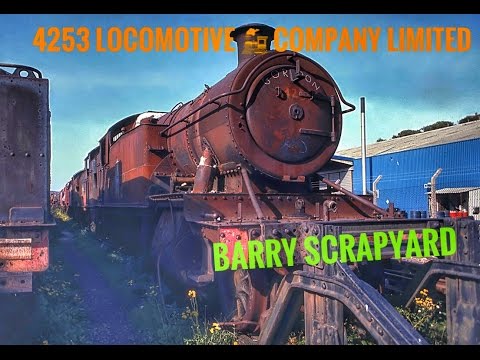
It was withdrawn in 1965 from Shrewsbury and was towed to Woodham Brothersscrapyard in Barry, South Wales.It languished there until 1974 when it was rescued for preservation. It was initially taken to Oswestry for restoration work, but is now based on the Llangollen Railway, a restored part of the Ruabon Barmouth Line, and it has seen regular services on the Llangollen Railway and has been on loan to the West Somerset Railway, Gloucestershire & Warwickshire Railway, South Devon Railway, Keighley and Worth Valley Railway, Great Central Railway (Nottingham) and even The North Yorkshire Moors Railway. 7822 returned to service in early 2016 following heavy boiler repairs and can be seen regularly operating at Llangollen.
The branch line is now officially closed, and has been since 2014. Passenger trains stopped running on this line in 2001 and then to freight and steam trains in 2009. Up until now, the line is starting to be dismantled as Network Rail concluded it is not going to be worth spending millions to get the line up and running again.
The old branch line from the South Eastern Main Line at Folkestone Junction served the port of Folkestone and provided a rail connection for boat trains from London which connected with the ferry services to Calais and Boulogne in France. At the start of the video, we see the remains of Warren Road Level Crossing, originally an MCB-CCTV level crossing type. Originally, before wigwags came along, this crossing was an MWG type crossing (Manually Worked Gates) with white swing gates and a red circle in the middle. Luckily, Google Maps still have images of the crossing in 2009 when it had NRS Halogen Bulb Wigwags, very old GWE Barriers with Halogen Barrier Boom Lights and intermittent bells. These were taken out between 2012 and 2014, with a fence put in place. All that remains now are red Trespass notices and beware of the live rail, despite the railway being abandoned with no trains for 5 years
Following the line south along the A260, we eventually pass a foot crossing. Pedestrians can still cross here but either side of the pathway are the same fences seen at the Warren Road crossing.
The road slowly goes downwards and the railway crosses the harbour. A very unique railway swing bridge is placed right beside the old Folkestone Harbour Station and Level Crossing. It looks to be in the process of being restored as its a grade 2 listed building.
Some of the photos here do not belong to me (i.e. ones from Google Maps). These images can be found on the Google Maps street view on Warren Road in Folkestone in May 2009.
The remains of the Folkestone Harbour Station and Level Crossing can be seen in a different video taken at night to make it more ere, abandoned and old! were just cutting the video for the station update
This is a video showing a drive down the abandoned (or more appropriately called "to be dismantled") Folkestone Harbour Branch line from the former Warren Road MCB-CCTV Level Crossing to the end of the branch line at Folkestone Harbour Railway Station. It was recorded in April 2017.
No. 19 Norwegian NORWEGIAN STATE RAILWAY 21C CLASS 2-6-0 TENDER LOCOMOTIVE on the kent and East Sussex Railway
The only tender locomotive on the K&ESR, No. 19 arrived in 1971 having been purchased privately and transported from Oslo.
No. 19 was built for the Norwegian State Railway (NSB) by the Swedish firm of Nydquist and Holm (works No. 1163) at Trollhattan in 1919. Eight such locomotives were constructed and designated class 21c. They developed from an earlier series of 2-6-0 moguls built for the NSB. The first three had been built by Messrs Dubs and Company of Glasgow in 1891, the design being credited to David Jones of the Highland Railway. There is also one preserved in Norway and another (No. 377) in this country.
Given the running number 376, this locomotive and its sisters were built for use on the Kongsvingar line in south eastern Norway. Displaced from there, No. 376 ended its days as motive power for snow plough work at Grong on the Nordland line, some 60 miles north of Trondheim. An interesting feature of the 38 ton locomotive was the enclosed cab fitted to provide shelter during the long hours of darkness encountered in the north of Norway. A headlamp is also fitted above the smokebox door, current being provided by a steam generator mounted above the firebox.
After arrival on the K&ESR it was fitted with a vacuum brake and retubed whilst retaining the airbrake for its own use. As K&ESR No. 19 it was regularly in service during 1974-76, but was withdrawn in 1977 for extensive overhaul and repairs.
Work proceeded only slowly and the locomotive changed hands several times. During 1984 it came into the ownership of the Norwegian Locomotive Trust. The tender had to be virtually rebuilt as the old one had suffered bad wastage and it was at this stage that the tender portion of the fully-enclosed cab was dispensed with. As far as the boiler was concerned, many stays needed to be replaced as did all tubes and superheater elements and a new smokebox and ashpan were also required. A particularly time consuming aspect of the overhaul was the valve gear which was very badly worn. The locomotive re-entered traffic in 1996 and was ceremoniously recommissioned by His Excellency the Norwegian Ambassador, the Patron of the Trust. Shortly afterwards the locomotive was named Norwegian.
The Locomotive was withdrawn for routine overhaul but returned to service in summer 2013.
Although the trackbed from Romney Junction towards New Romney is easily traceable, nothing remains of Lydd-on-Sea Halt today except for a gated concrete approach road from Kerton Road .
Promoted by holiday camp development in the area, the Southern Railway decided in 1937 to realign its branch line to New Romney (which had been opened in 1884) closer to the sea and to open two intermediate stations - Lydd-on-Sea and Greatstone-on-Sea.
The opening of Lydd-on-Sea on 4 July 1937 coincided with the closure of Dungeness station to passengers
it was intended that Lydd-on-Sea, ½-mile from Dungeness, would serve both locations and its running in board read "Lydd-on-Sea (for Dungeness)"
To handle the expected flow of holiday traffic, the station was equipped with a long curved island platform with a passing loop on which was perched a small wooden shed. The traffic never materialised and the station was downgraded to an unstaffed halt on 20 September 1954 when its passing loop was also lifted. As passenger traffic dwindled and freight became insignificant, the New Romney branch fell into decline and was listed for closure in the Beeching Report. In 1966 the Minister of Transport Barbara Castle announced her intention of closing the Appledore to New Romney Branch and passenger services ceased on 6 March 1967. Today (2017)
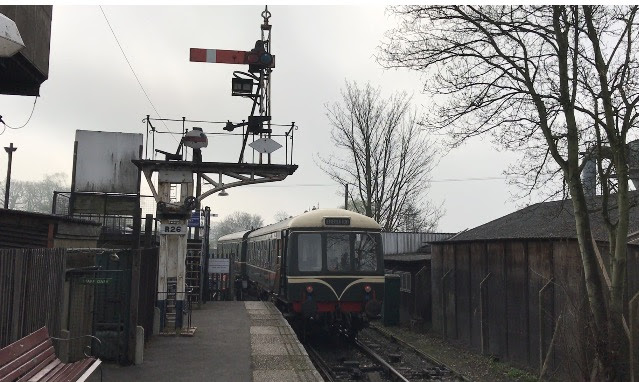
Started with a visit to Rolvenden station , as we arrived we was met by the DMMU just getting ready to go to Tenterden Town .we then climb up the spectators platform to view some of the stock outside the repair shed at the station
This is the view from the platform, from here you can see some of the rolling stock . in the picture is the the back of the Norwegian , and the Ford BTH BO BO ELECTRIC Featured on the video below.
Also from the platform we got a cracking view of the undercarriage of the 4253 , amazing job being done there. by all involved .
Ashford locomotive works was built by the South Eastern Railway on a new 185-acre (75 ha) site in 1847, replacing an earlier locomotive repair facility at New Cross in London.[1] By 1850 over 130 houses had been built for staff (called Alfred Town by the railway but New Town by everybody else),The works employed about 600 people in 1851 increasing to about 950 by 1861, and around 1,300 by 1882. A carriage and wagon works was opened on an adjacent 32-acre (13 ha) site in 1850.
South Eastern and Chatham RailwayOn 1 January 1899, the railway entered into a working union with the London Chatham and Dover Railway, forming the South Eastern and Chatham Railway (SECR).[5][6] Each antecedent company had its own locomotive works, but Ashford was larger than Longhedge works and so became the principal locomotive works for the new organisation. The latter facility was gradually run down and converted into a subsidiary works.
Southern Railway and British Railways
Following the grouping of the SECR with the London, Brighton and South Coast Railway and the London and South Western Railway to form the Southern Railway on 1 January 1923, most new locomotive and carriage design and construction was transferred to the more modern facilities at Eastleigh Works. Nevertheless, Ashford continued to operate both building and servicing locomotives and wagons until well after the nationalisation of the railways to form British Railways in 1948.
The locomotive workshops eventually closed on 16 June 1962, the last locomotive to be repaired at Ashford being N class 2-6-0 no. 31400 on 9 June.[9] The wagon works continued for a further two decades[4] producing continental ferry vans, Freightliner vehicles, merry-go-round coal hopper wagons and the Cartic4 articulated car transporter.[10] [8] It became one of BREL's main wagon works, but as trade declined it operated on an ever-decreasing scale until it closed down in 1982
This locomotive, was built at Swindon in 1926 and spent its working life in and around Cardiff Valley hauling both freight and passenger trains. Like many others, 5668 ended up sold to Woodham’s scrap yard at Barry in November 1964 as steam was phased out in favour of diesel. It languished there, slowly losing parts, until rescued and moved to the Pontypool & Blaenavon Railway in 1987. A very similar story to that of GWR 4253.
Towards the end of 2012
The kent and East Sussex Railway offered this locomotive as part of a package deal involving a substantial quantity of parts that were required to progress the restoration of 4253.
The agreement was that The 4253 Locomotive Company Limited would undertake the restoration of 5668 but that no work would commence until such time as 4253 had been completed and returned to steam.
At the 2013 AGM, shareholders voted in favour of proceeding with the deal and suggested an appeal be launched to raise funds to pay for the transportation of the loco from Blaenavon to Rolvenden. In excess of £2.6k was raised and, in late 2013, 5668 was moved to its new home.
Although no restoration work will begin for some years, it is important that the loco does not deteriorate
5668 was moved to Rolvenden yard where it was cleaned up and greased as necessary to provide some protection.
It has now been carefully sheeted and returned to Wittersham Road siding for storage to await its turn to be bought back to life.
As a result of this deal our railway, the Kent & East Sussex, will be assured that yet another powerful steam locomotive will be added to its fleet in due course to haul passenger trains on the extended line from Tenterden to Robertsbridge
Harbour to be sealed off as bomb is dug up at Folkestone seafront
Will this hold up the eagerly awaited Folkestone Seafront redevelopment will see the harbour station renovated. work is now pushing ahead at full steam ..
with no sign of a train in site !!!!!
Work is already being carried out to restore and repair the historic and listed harbour viaduct and swing bridge and the harbour station
The viaduct, which once carried trains into the harbour, will become a new pedestrian walkway for people to walk along the old platforms, down the tracks and onto the Harbour Arm pier.
another development will see the arrival of
These historic carriages, which have sat on the Wearside seafront for decades, will house a restaurant at Folkestone harbour’s historic railway station.
now plan are at thought to rebuild the loco to support the future extension of KESR to Robertsbridge when larger motive power with more capacity will be required. for 4253, which will be able to take a full five car train the length of the line with little difficulty.
Tenterden is a town with a large conservation area in the Ashford District of Kent, England. It stands on the edge of the remnant forest The Weald, overlooking the valley of the River Rother. It was a member of the Cinque Ports Confederation. Its riverside today is not navigable to large vessels and its status as a wool manufacturing centre has been lost. Tenterden has several voluntary organisations, some of which are listed below, seven large or very old public houses within its area and has long distance walking and cycling routes within its boundaries.
The town's name is derived from the Old English "Tenet Waraden", meaning a den or forest clearing in the forest which belonged to the men of Thanet.
History
The first record of dwellings in Tenterden can be found in a charter which mentions that it, as 'Heronden', began to grow from the 14th century around the strong local wool industry. Unlike other such centres in the Weald it had the advantage of access to the sea. Much of what is now Romney Marsh was under water, and ships docked at nearby Smallhythe. Timber from the Wealden forests was used to construct ships, and in 1449 Tenterden was incorporated into the Confederation of Cinque Ports as a limb of Rye. Ships built in the town were then used to help Rye fulfil its quota for the Crown.
A school was in existence here in 1521; later (in 1666) it was referred to as a grammar school. Today Homewood School and Sixth Form Centre, a large secondary school catering for the Weald and south of Ashford Borough is in Tenterden.
In 1903, Tenterden Town railway station was opened. It closed in 1954, but half of it reopened in 1974 as the Kent and East Sussex Railway. The route starts at Tenterden Town Station and finishes at Bodiam station, near Bodiam Castle. The main line track is being extended to Robertsbridge
Churches and chapels
There are two parish churches, as well as a number of other chapels and religious meeting spaces:
St Mildred's (Anglican) is in the main part of the town. The church dates from the 12th century, and was progressively enlarged until 1461, when the distinctive tower was constructed. It was one of the churches in the 1588 system of warning beacons.
It was a major surveying point in the Anglo-French Survey (1784–1790) to calculate the precise distance between the Paris Observatory and the Royal Greenwich Observatory, overseen by General William Roy.
St Michael and All Angels (Anglican). The suburb now called St Michael's was known as Boresisle until Victorian times, when a church dedicated to St Michael was built to serve this community. The church was consecrated in 1863, but construction of the steeple took a further 12 years.
St. John the Baptist (Anglican).
St. Mary's Church (Anglican).
St. Andrew's Catholic Church.
Trinity Baptist Church.
Zion Baptist Church.
Jireh Chapel: Strict Baptist church.
The Methodist Church.
The Unitarian Chapel, originally called the Old Meeting House, was built c. 1695. A plaque on the wall records that Dr Benjamin Franklin worshipped here in 1783, where he was to hear Joseph Priestley preach.
The Jehovah's Witness Kingdom Hall.stings) in East SuPublic houses
Its large and/or old pubs are generally owned by Kentish breweries and are:
The Woolpack, next to the Town Hall,
The White Lion, the High Street
The Vine, the High Street
The William Caxton, the High Street,
The Crown, Ashford Road in St. Michaels
ssex.
One of the endearing features of most preserved railways is the various coaches,wagons and trains to be seen from the train,why your sitting there having your cream tea .or stretching your legs for a walk around Wittersham road.
Inevitably they are in various states of repair. and now thanks to the Rother Valley Railway
the kent and east sussex railway has a large facility .
The building was paid for by The Rother Valley Railway, who are working on laying track towards Bodiam from Robertsbridge to give the a connection from Tenterden with Network Rail.
The carriage storage facility won an award from the Institute of Civil Engineers, partly due to it being built for the relatively small amount of £500,000.
The engine that brought down a German Bomber , Lydd Station On 27 November, a train came under attack by two Focke-Wulf 190s. The train, hauled by Southern Railway D3 number 2365 which was just departing from Lydd Town railway station, had its boiler hit. The resulting jet of high pressure steam from the engine hit the plane, causing it to crash-land nearby; the pilot was found dead, but no railway staff or passengers were injured. The two planes had been heading over the coast after a raid on Ashford.
A local newspaper reported that it was the New Romney line’s most famous day when a train brought down an enemy fighter! On 27th November 1942 a train hauled by an ex-LBSCR D3 class locomotive was attacked by a low-flying German fighter aircraft. A cannon shell from the ‘plane burst the D3’s boiler just as the plane flew 20 feet above. The plane crashed, the pilot was killed whilst the train and driver survived! The loco was rebuilt and back in service by 11th March
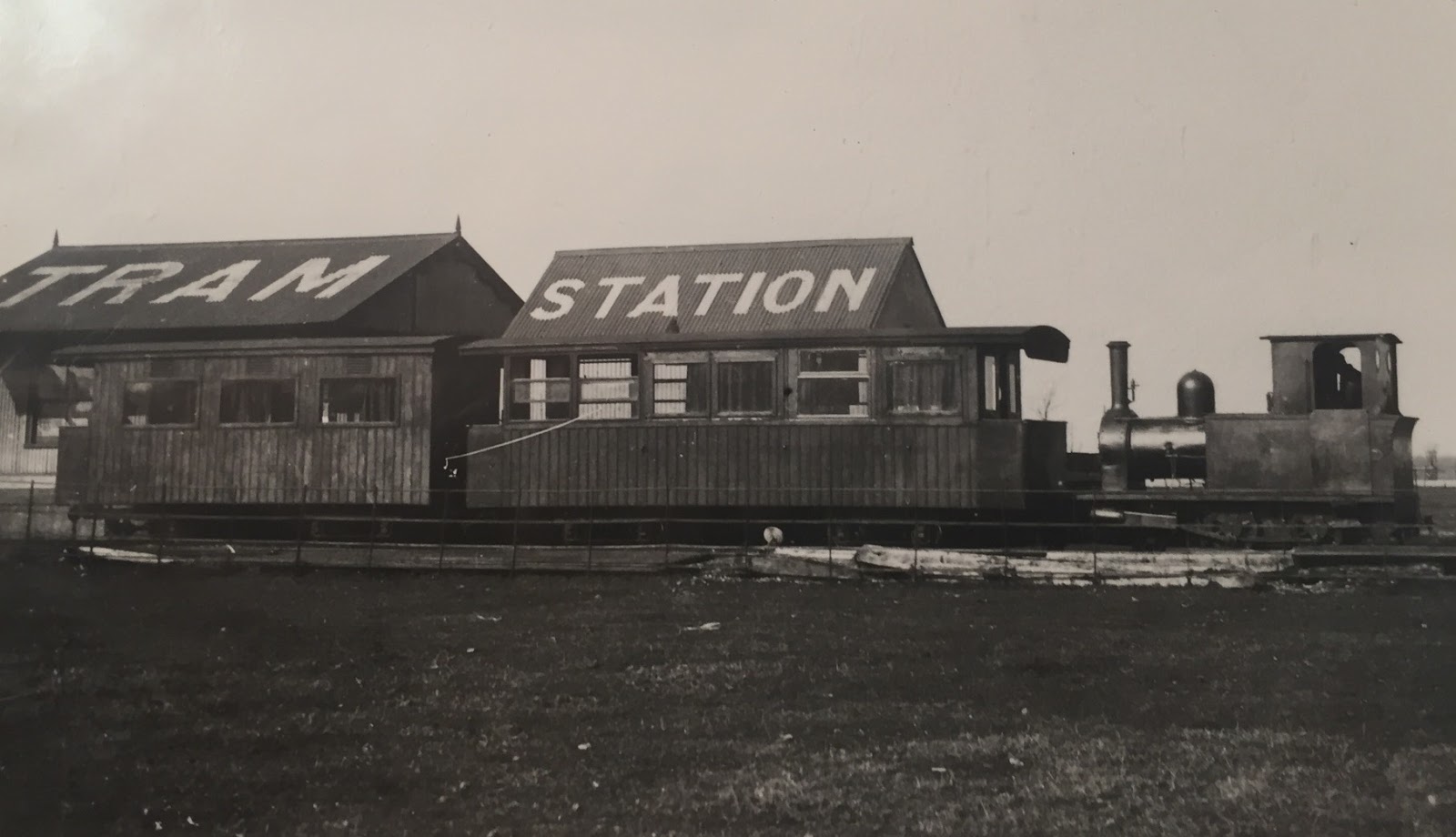
Camber golf links, Rye and Camber Tramway was a railway in East Sussex in 1895 the Rye and Camber Tramway was opened to connect Rye with a new golf course at Camber.
Rye Tramway
Designed to cater for the transportation needs of golfers and their caddies, the steam railway also took fishermen from Rye to their fishing boats moored opposite Rye Harbour village, where a river ferry could be hailed.
Rye (Tramway top right )
The line's promoters cunningly decided to build the line entirely on private land, thereby avoiding the necessity of having to obtain an Act of Parliament.
Built to a 3ft gauge with economy in mind, the 1.75 mile line ran parallel to the River Rother from its Rye terminus as far as Broadwater Beach, before heading across Northpoint beach and terminating opposite Rye Harbour Village
The track was spiked directly to wooden sleepers to save cost, and there was two loops at each end of the line to let the engines run around the coaches.
you tube clip of the tramway
The two termini were both built of corrugated iron and wood, offering a canopy, waiting room and booking office.
With only one engine in steam at any given point, there was no need for signalling.
When it opened on Saturday, 13th July, 1895, the line was equipped with one steam engine and a passenger coach, divided into first and second class compartments.
The engine, named 'Camber' and accompanying carriage were built by W.G.Bagnall Limited of Stafford.
Although capable of better things, the engine normally sauntered around the track at a stately 10mph, pulling a three ton passenger car.
The coach, divided into first and second class sections, was around twenty-six feet long with entrance platforms at each end.
The first class portion could accommodate 12 passengers and came with cushioned seats and curtains, while the cheapskates in second class had to make do with longitudinal strip-wood seating .
Traffic was encouraging, with 18,000 tickets being sold in the first six months, prompting the company to invest in a second, more powerful, steam engine in 1897, patriotically named 'Victoria'.
The company continued to prosper, adding a half mile extension to a deserted location at Camber Sands on 13th July, 1908.
The station was extremely low on facilities, offering nothing more than a raised platform made from old standard gauge sleepers, with a small hut being added later.
Endeavouring to make the most of its remote location, the timetable described the station as being 'far from the madding crowd' and a perfect location for picnics.
With the extension complete, the original Camber terminus was renamed as Golf Links, and the service ramped up in the summer months to 13 trains each way daily, of which only seven ran through to Camber Sands.
A special Saturday late night train ran for golfers at 8:15pm.
In the winter months, the service was cut back to seven trains each way daily, nine trips on Saturdays and four on Sunday, with all trains terminating at the Golf Links station.
Road competition, rising coal prices and high maintenance costs forced economies on the line in the 1920s, with the steam locomotives being replaced by a four wheeled petrol tractor in 1924. The winter service was abandoned completely in 1925-6 and a long period of decline set in.
With the outbreak of war in 1939, the line was closed to the public and used by various military and naval purposes.
Unhappily, the track and rolling stock was in such dreadful condition at the end of the war that the company decided to wind up the railway forever.
Although the Golf Links/Camber station has survived remarkably well for a corrugated iron structure, no trace remains of the Rye terminus or the station at Camber Sands.