11 May 2017 and Foxy becomes "The Cornish Riviera Express " on The Kent and East Sussex Railway
The Cornish Riviera Express is a express passenger train that has run between London Paddington and Penzance in Cornwall since 1904. Introduced by the Great Western Railway, the name Cornish Riviera Express has been applied to the late morning express train from London to Penzance continuously through nationalisation under British Rail and privatisation under First Great Western, only ceasing briefly during the two World Wars. The name is also applied to the late morning express train running in the opposite direction from Penzance to London. Through performance and publicity the Cornish Riviera Express has become one of the most famous named trains in the United Kingdom and is particularly renowned for the publicity employed by the Great Western Railway in the 1930s which elevated it to iconic status.
Today it is operated by Great Western Railway (train operating company).
Locomotive No. 7822 "Foxcote Manor" first day of service on the Kent and East Sussex Railway
7822 - affectionately known as ‘Foxy’
The visit is - in part - sponsored by the Kent & East Sussex Railway Guest Engine Club, setup by volunteers 18 months ago to encourage the hire of guest engines to enhance the railway’s home fleet when possible.
The locomotive was originally allocated to Oswestry depot, where it was used to haul both passenger and freight services over lines such as the Cambrian Line and the now-closed Ruabon Barmouth Line. It regularly hauled the "Cambrian Coast Express" from Shrewsbury to Aberystwyth. It was also allocated to Chester shed during its lifespan.
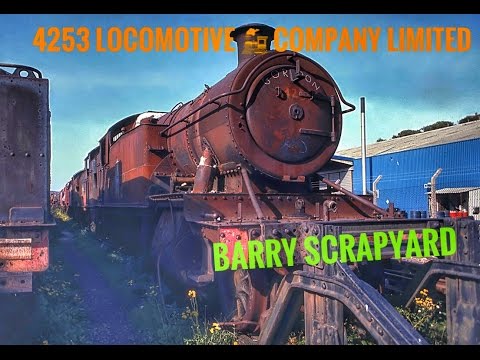
It was withdrawn in 1965 from Shrewsbury and was towed to Woodham Brothersscrapyard in Barry, South Wales.It languished there until 1974 when it was rescued for preservation. It was initially taken to Oswestry for restoration work, but is now based on the Llangollen Railway, a restored part of the Ruabon Barmouth Line, and it has seen regular services on the Llangollen Railway and has been on loan to the West Somerset Railway, Gloucestershire & Warwickshire Railway, South Devon Railway, Keighley and Worth Valley Railway, Great Central Railway (Nottingham) and even The North Yorkshire Moors Railway.
7822 returned to service in early 2016 following heavy boiler repairs and can be seen regularly operating at Llangollen.
This machine is an early 1960’s Plasser & Theurer VKR 05-E tamper DX74108. Apparently the tamping tines should vibrate with the ideal frequency of exactly 35 Hz. This directional, linear vibration combined with the non-synchronous tine movement produces a homogeneously compacted ballast
This locomotive, was built at Swindon in 1926 and spent its working life in and around Cardiff Valley hauling both freight and passenger trains. Like many others, 5668 ended up sold to Woodham’s scrap yard at Barry in November 1964 as steam was phased out in favour of diesel. It languished there, slowly losing parts, until rescued and moved to the Pontypool & Blaenavon Railway in 1987. A very similar story to that of GWR 4253.
Towards the end of 2012
The kent and East Sussex Railway offered this locomotive as part of a package deal involving a substantial quantity of parts that were required to progress the restoration of 4253.
The agreement was that The 4253 Locomotive Company Limited would undertake the restoration of 5668 but that no work would commence until such time as 4253 had been completed and returned to steam.
At the 2013 AGM, shareholders voted in favour of proceeding with the deal and suggested an appeal be launched to raise funds to pay for the transportation of the loco from Blaenavon to Rolvenden. In excess of £2.6k was raised and, in late 2013, 5668 was moved to its new home.
Although no restoration work will begin for some years, it is important that the loco does not deteriorate
5668 was moved to Rolvenden yard where it was cleaned up and greased as necessary to provide some protection.
It has now been carefully sheeted and returned to Wittersham Road siding for storage to await its turn to be bought back to life.
As a result of this deal our railway, the Kent & East Sussex, will be assured that yet another powerful steam locomotive will be added to its fleet in due course to haul passenger trains on the extended line from Tenterden to Robertsbridge
Razed to the ground after complete closure by British Railways in 1961, this station has risen from the ashes under the auspices of the preserved ‘’Kent & East Sussex Railway’’ (K&ESR). Wittersham Road originally came into passenger use with the ‘’Rother Valley Railway’’ (RVR) between Robertsbridge and Tenterden on 2nd April 1900, goods traffic having commenced on 29th of the previous month. As mentioned elsewhere on the website, the line was subject to a 1⅓-mile eastward extension to a more conveniently-sited ‘’Tenterden Town’’ station, and was eventually taken as far as Headcorn, where it met the ex-SER Dover trunk line. These extensions came into use on 16th March 1903 and 15th May 1905 respectively, and the RVR became known as the K&ESR from 1904 onwards.
The line was engineered by Holman F. Stephens, and architecture was standardised along the route, a practice which had been followed by numerous of the larger railway companies nationwide. The route was single-track throughout, and in common with most stations on the line, just a single brick-built platform surface was provided at Wittersham Road. The station resided 2¼-miles northwest of the village it purported to serve, hence its ‘’Road’’ suffix, and its construction certainly seemed reminiscent of the old SER policy of providing stations at a ‘’modest cost’’! Wittersham Road’s main building was a typical unassuming H.F. Stephens affair: single-storey, it was fully fabricated from corrugated iron – as per all those structures in-between Robertsbridge and Tenterden Town exclusive – and incorporated sash-style windows. The fact that the building was erected at right angles to the platform seems to explain why it was the only station structure along the entire route to lack a canopy. The very same style of construction could be found on H.F. Stephens’ contemporary Sheppey Light Railway in North Kent, and on those railways he engineered in far flung locations in Shropshire and Wales.
Wittersham Road’s platform was lined at its rear by wire fencing, which in turn was accompanied by rectangular-shaped gas lamps supported upon wooden posts. Behind the platform could be found the station’s goods facilities, which comprised a pair of Tenterden-facing sidings, access to which was controlled from a lever frame positioned north east of the layout. Signalling at the site was primitive, simply comprising a double-armed semaphore post at the Robertsbridge end of the station platform, which resided immediately adjacent to a level crossing. The latter was protected by a pair of timber gates, to which were affixed a red warning diamond, as opposed to the more customary circle. This was not unique to Wittersham Road, a number of other level crossings along the route being similarly treated. It is worth noting that the station lacked a loop, thus it was not possible for trains to pass in the station (unless, in an extreme case, a train service was stabled in the goods yard to let another pass!).
Naturally, the station led a quiet existence on a decidedly rural route, but the monotony was broken as a result of World War II. In February 1941, the goods yard became host to a 32-ton rail-mounted gun, which could fire 9.2-inch diameter shells, and had a range of twenty miles. Thus, in the event of an invasion, the gun’s fire was able to hit the coastline of the Romney Marsh. The gun was not used in anger, although was test fired, and to move the colossus, an ex-GWR 0-6-0 ‘’Dean Goods’’ locomotive, now under ‘’War Department’’ ownership, was provided on the line. The locomotive was also used to move an identical gun based at Rolvenden. To accommodate the gun at Wittersham Road, an ammunition store was erected in the goods yard, as was a gun crew hut. A military presence remained at the station until August 1944.