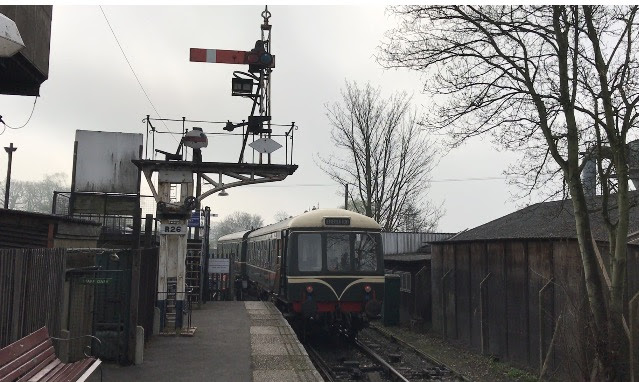
Started with a visit to Rolvenden station , as we arrived we was met by the DMMU just getting ready to go to Tenterden Town .we then climb up the spectators platform to view some of the stock outside the repair shed at the station
This is the view from the platform, from here you can see some of the rolling stock . in the picture is the the back of the Norwegian , and the Ford BTH BO BO ELECTRIC Featured on the video below.
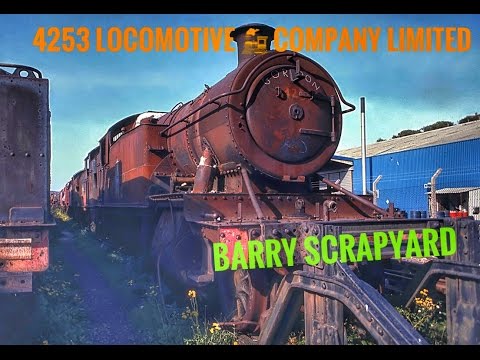
Also from the platform we got a cracking view of the undercarriage of the 4253 , amazing job being done there. by all involved .
Urban Exploration: Abandoned Train Station in Lydd Kent . APRIL2017
One of my favourite abandoned stations Lydd Town Station (formerly Lydd Station) (Closed) and Lydd Town Crossing Opened on 7 December 1881 as Lydd Station, on 4 July 1937 the station was renamed Lydd Town to prevent confusion with a newly opened station at Lydd-on-Sea.
Lydd Town Station was a substantial facility, with a large goods yard and much passenger and freight traffic generated by nearby army camps. A branch ran south from the goods yard into the army camps, which were served by Lydd Military Railway. A passing loop was provided at the station, but this has subsequently been lifted. The station was closed to passenger traffic on 6 March 1967 and to freight on 4 October 1971. Part of the site is now used as a recycling facility. There is a possibility that gravel extraction will restart south of the station, and, if so, the passing loop may be reinstated to allow locomotives to change ends and shunt the train.
If open today Lydd Town Station would serve a growing town, which is just south west of the site, and a short extension to the line could also provide much improved transport facilities to Lydd Airport (also known as London Ashford), linking directly to Ashford International Station.
The branch actually runs south east from Appledore. The convention adopted in these collections is that Appledore is north, Dungeness is south, the New Romney side of the branch is east, and the Lydd side of the branch Urban exploring is a great way to explore your local community i would recommended a GO PRO https://www.amazon.co.uk/gp/product/B00O46894K/ref=as_li_qf_sp_asin_il_tl?ie=UTF8&camp=1634&creative=6738&creativeASIN=B00O46894K&linkCode=as2&tag=trackwalke-21
The next stage of the eagerly awaited Folkestone Seafront redevelopment will see the harbour station renovated. work is now pushing ahead at full steam ..
with no sign of a train in site !!!!!
Work is already being carried out to restore and repair the historic and listed harbour viaduct and swing bridge and the harbour station
The viaduct, which once carried trains into the harbour, will become a new pedestrian walkway for people to walk along the old platforms, down the tracks and onto the Harbour Arm pier.
another development will see the arrival of These historic carriages, which have sat on the Wearside seafront for decades, will house a restaurant at Folkestone harbour’s historic railway station.
The line was engineered and operated by Colonel H F Stephens. One of his 'bigger' feats was St Michaels Tunnel, located just north of the halt. Opened in 1905 as part of an extension from Tenterden to Headcorn, it is just 31 yards in length and curves to the east on a radius of approximately 30 chains.
Comprising a single platform and small corrugated hut, the modest halt at St Michaels was added to the Kent & East Sussex Light Railway in 1912.
Provided by colonel Stephens Museum
To serve a small community on the outskirts of Tenterden. Its ticket office - if you could call it that - closed in 1938 and the local infrastructure's decline continued until services were withdrawn on 4th January 1954.
The portals are neat, brick-built affairs with a masonry string course and copings. Wing walls extend outwards parallel to the track - the east-side wall at the south end is cracked top to bottom. Horseshoe shaped in profile, the lining comprises four rings of brick and features a single refuge. Timber brackets supported telegraph wires.
Provided by colonel Stephens Museum
Despite 60 years of redundancy, the structure remains in fair condition except for the cracked wing wall and some spalling of the north portal's headwall. The interior has found function as a wood store, used by the householder whose property it stands on.
Abandoned Railway tunnel - St Michaels Tunnel on the Kent and East Sussex Railway
Provided by colonel Stephens Museum
Provided by colonel Stephens Museum
Abandoned Railway tunnel - St Michaels Tunnel on the Kent and East Sussex Railway
Fairfield church lies between Brenzett and Brookland on a minor road in a deserted part of the Romney Marsh .
St Thomas à Becket, Fairfield church by framemeplease
The area was won from the sea , sometime between 1200 and 1270. The monks from Canterbury built dykes to the western edge of the Rhee Wall (the sea defenses built by the Romans) and enclosed the land so reclaiming the rich and fertile soil from the sea.
St Thomas à Becket, Fairfield church by framemeplease
The year 1287 saw the great storm in which Broomhill was swept away and New Romney barely survived. The Rother luckily changed its course to the sea, and exited the marshes at Rye, whereas before the storm the river found its way to the sea near to modern day Greatstone and littlestone
Fayrefelde existed before 1595 as a map of the time shows the village approximately where the church now sits. It is likely that as the land became more reclaimed so the village sprung up.
Nowadays all that can be seen is the church lying down from the road embankment which is probably the original inning wall. The church was built as a temporary structure of timber lath and plaster in the 1200's to support the local farming community. The exterior has been strengthened with brick, and in 1913 the whole building was reconstructed and encased to preserve it.
St Thomas à Becket, Fairfield church by framemeplease
St Thomas à Becket, Fairfield church by framemeplease
The church has been used as a filming location, including for:
Dungeness (SER) railway station Disused and abandoned
Dungeness was the terminus of the Lydd Railway Company's branch from Appledore which opened on 7 December 1881. Passenger services initially terminated at Lydd, although a goods service operated as far as Dungeness.
Opened to passengers on the 1st April 1883, the single platform terminus at Dungeness lay at the end of a branch line from the South Eastern Railway's station at Appledore.
Dungeness railway station, 1905
Built by the Lydd Railway Company, the service was provided by the South Eastern Railway who eventually absorbed the smaller company in 1895.
The eight mile branch had no less than 12 level crossings, with stations at Appledore, Brookland Halt, Lydd Town, (Lydd-on-Sea Halt and Greatstone-on-Sea Halt from 4 July 1937) and New Romney & Littlestone-on-Sea and Dungeness.
https://framemeplease19.wixsite.com/trackbedwalker A large army camp and military ranges at Lydd kept the line busy until the end of WW1, but by the 1920's Dungeness was served by just three trains a day, while New Romney station enjoyed 9 trains a day.
A realignment of the line along the coast to New Romney in 1937, saw passenger services being withdrawn from Dungeness on the 4th July, 1937
The growing popularity of driving a car saw passenger numbers rapidly decline along the rest of the line in the 1950s, with the Dungeness freight service being withdrawn in 1952. Work on the Dungeness Nuclear Power Station in the early Sixties brought a new, albeit brief, lease of life to the line, with two-car diesel-electric trains providing 11 trains a day in 1962, most running through to Ashford. Proposed for closure in the infamous Beeching Report of 1963, passenger services managed to cling on to life until the 6th March 1967, with goods services to New Romney already being withdrawn three years earlier.
Goods services to Lydd continued until 1971, with the line remaining in use for the removal of ballast aggregates and waste from Dungeness B nuclear power station.
All track beyond Romney Junction has now been lifted with the remaining track only seeing very occasional troop trains and railtours.
Disused , Abandoned Lydd Town Station (formerly Lydd Station)
You Tube
Opened on 7 December 1881 as Lydd Station, on 4 July 1937 the station was renamed Lydd
Town to prevent confusion with a newly opened station at Lydd-on-Sea.
google photo
One of my favourite abandoned stations Lydd Town Station (formerly Lydd Station) (Closed) and Lydd Town Crossing
Opened on 7 December 1881 as Lydd Station, on 4 July 1937 the station was renamed Lydd Town to prevent confusion with a newly opened station at Lydd-on-Sea
Lydd Town Station was a substantial facility, with a large goods yard and much passenger and freight traffic generated by nearby army camps.
A branch ran south from the goods yard into the army camps, which were served by Lydd Military Railway. A passing loop was provided at the station, but this has subsequently been lifted. The station was closed to passenger traffic on 6 March 1967 and to freight on 4 October 1971. Part of the site is now used as a recycling facility.
PHOTO Framemepleae2017
The passing loop was reinstated to allow locomotives to change ends and shunt the train.
The Lydd Railway Company's 11-mile branch to Dungeness opened to freight services in December 1881. Initially passenger trains terminated at Lydd. The line's promoters hoped that creating a rail link between London and Dungeness would lead to the development of a port from which cross-channel steamers could operate. But this grand plan failed to materialise and the branch was left to stagnate. It did though carry some shingle traffic as well as flints for the Potteries where they were used to glaze china. Many army trains travelled to Lydd where a private military railway system had a connection onto the main line.
The branch actually runs south east from Appledore. The convention adopted in these collections is that Appledore is north, Dungeness is south, the New Romney side of the branch is east, and the Lydd side of the branch