Its easy to take for granted the awesome endeavors of 19th Century railway pioneers which thread us through, around or over the nation's natural barriers. It was an age of speculative adventure, built on innovation, will power and elbow grease.
But many magnificent creations were abandoned during the industrial vandalism of the Fifties and Sixties.
today armed with my go pro
and my cannon
we capture these forgotten,abandoned and disused relics
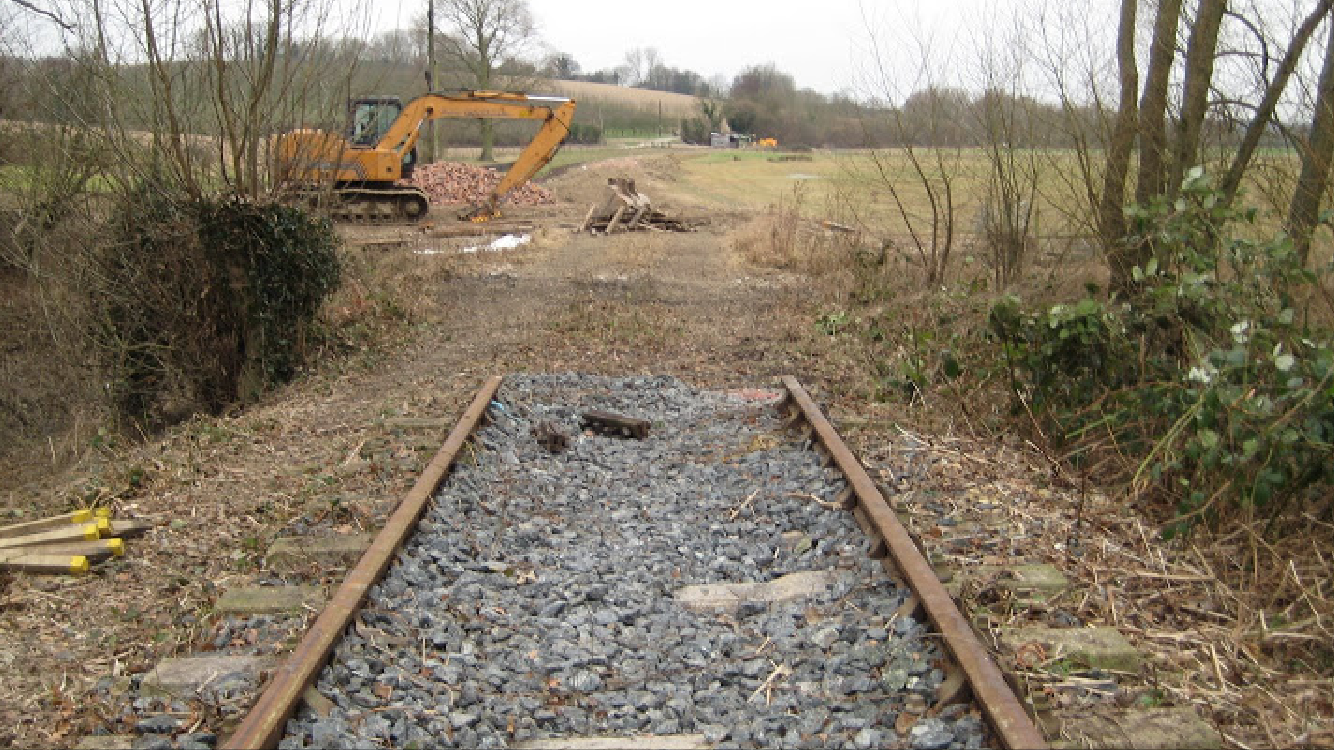
The Rother Valley Railway, a preservation group set up in 1991
And by March 2009 they had laid track from Bodiam to within 200 yards (180 m) of the site of Junction Road Halt at a cost of £200,000.
Track was relaid through the site of the halt in June 2010. On 18 March 2011, a VIP dining special was the first passenger train to traverse the rebuilt line. The following weekend of 19/20 March saw Kent and East Sussex Railway services run as far as Junction Road Now planning is agree , take a look at the next stages
Ashford locomotive works was built by the South Eastern Railway on a new 185-acre (75 ha) site in 1847, replacing an earlier locomotive repair facility at New Cross in London.[1] By 1850 over 130 houses had been built for staff (called Alfred Town by the railway but New Town by everybody else),The works employed about 600 people in 1851 increasing to about 950 by 1861, and around 1,300 by 1882. A carriage and wagon works was opened on an adjacent 32-acre (13 ha) site in 1850.
South Eastern and Chatham RailwayOn 1 January 1899, the railway entered into a working union with the London Chatham and Dover Railway, forming the South Eastern and Chatham Railway (SECR).[5][6] Each antecedent company had its own locomotive works, but Ashford was larger than Longhedge works and so became the principal locomotive works for the new organisation. The latter facility was gradually run down and converted into a subsidiary works.
Southern Railway and British Railways
Following the grouping of the SECR with the London, Brighton and South Coast Railway and the London and South Western Railway to form the Southern Railway on 1 January 1923, most new locomotive and carriage design and construction was transferred to the more modern facilities at Eastleigh Works. Nevertheless, Ashford continued to operate both building and servicing locomotives and wagons until well after the nationalisation of the railways to form British Railways in 1948.
The locomotive workshops eventually closed on 16 June 1962, the last locomotive to be repaired at Ashford being N class 2-6-0 no. 31400 on 9 June.[9] The wagon works continued for a further two decades[4] producing continental ferry vans, Freightliner vehicles, merry-go-round coal hopper wagons and the Cartic4 articulated car transporter.[10] [8] It became one of BREL's main wagon works, but as trade declined it operated on an ever-decreasing scale until it closed down in 1982
Kent and East Sussex Railway and Rother Valley Railway Extension to Udiam Farm from Bodiam
The Rother Valley Railway, a preservation group set up in 1991, had by March 2009 laid track from Bodiam to within 200 yards (180 m) of the site of Junction Road Halt at a cost of £200,000.
Track was relaid through the site of the halt in June 2010.
On 18 March 2011, a VIP dining special was the first passenger train to traverse the rebuilt line.
The following weekend of 19/20 March saw Kent and East Sussex Railway services run as far as Junction Road
It was of 3 ft (914 mm) narrow gauge, relatively unusual amongst British narrow gauge railways. It operated from 1895 until 1939, connecting Rye to the coast. It was about 13⁄4 miles (2.8 km) in length, and had three stations - Rye, Golf Links and Camber Sands. It operated mainly to transport golfers to the golf links and holidaymakers to the coastal dunes.
3⁄4 miles (2.8 km) in length, and had three stations - Rye, Golf Links and Camber Sands. It operated mainly to transport golfers to the golf links and holidaymakers to the coastal dunes. The railway was constructed between January and July 1895 and ran entirely on private land. It was the first designed by consulting engineer Colonel Holman F. Stephens, who went on to build and run small railways all over the Country.
The line was built to convey golfers to the Rye Golf Club and ran from Rye station to the golf club. In 1908 the first extension to Camber Sands station was opened and the intermediate station renamed "Golf Links". Camber terminal was moved to a more accessible site and a tea hut was opened at the end of summer 1938, but this only used for a few months as the war intervened the next year.
Although initially quite successful, increasing competition from automobile and bus transport eventually caused the tramway to enter a gradual economic decline, as was the case with many small railways. Passenger service was ended at the outbreak of World War II but it was extensively used by the Government to convey parts for the P.L.U.T.O. (Pipe Line Under The Ocean) project for which a special siding leading to a new pier near Golf Links Station was constructed by Canadian troops.
The line was in such a run-down a condition by the end of the war that it was deemed irrecoverable and was sold for scrap in 1947. The Rye & Camber Tramways Co. Ltd was liquidated in February 1949. Remains A number of relics, including the frame and bogies of one of the carriages, can be seen at the Colonel Stephens Museum at Tenterden. Golf Links station building survives virtually intact. Some track is embedded in concrete near the station as the trackbed was used as a roadway during wartime. Most of the route is a footpath, although a short section has been destroyed by gravel workings. The line plays a prominent part in several novels by Rye resident E.F. Benson.
had by March 2009 laid track from Bodiam to within 200 yards (180 m) of the site of Junction Road Haltat a cost of £200,000 .
Track was relaid through the site of the halt in June 2010. On 18 March 2011, a VIP dining special was the first passenger train to traverse the rebuilt line. The following weekend of 19/20 March saw Kent and East Sussex Railway services run as far as Junction Road
The K&ESR owned two Terriers, the first bought in May 1901 and the second in February 1905, becoming No.3 “Bodiam” and No.5 “Rolvenden” respectively. Both were from the initial batch of six engines, four of which eventually came to Stephens’ railways. “Rolvenden”, the former LB&SCR No.71, had the honour of being the first Terrier built. “Bodiam”, although having the first number of the batch as LB&SCR No.70, was actually the last, having bequeathed her cylinders to 71, when a faulty casting had delayed her introduction into service (strange how these sisters were twinned from birth).
from the framemeplease collection
Both engines were painted in Stephens’ favourite blue livery with red lining, but without a polished dome. With regular overhauls, including that of “Bodiam” at Eastleigh in 1919 and “Rolvenden” at Brighton in 1917, they gave excellent service until the depression years.
from the framemeplease collection
They were alike as two peas for much of their lives together even to the near simultaneous acquisition of three rail coal bunker extensions (the LB&SCR extensions had four); the only difference being a long-strapped A1X type door carried by “Rolvenden”, probably acquired at Brighton. Although the two Ilfracombe Goods engines acquired in 1910 and 1914 became the favoured engines, the Terriers were the mainstay of the line in the Edwardian era, and much used thereafter.
Both engines seem to have received their last partial re-tube in late 1928, with “Bodiam” falling into disuse around the time of the railway’s receivership in 1931. (There is photographic evidence of her apparently in steam questionably dated as 12th September in that year.) “Rolvenden” seems to have lasted a little longer. They were then dumped in the works yard but “Bodiam” was resurrected in 1933 and repaired over the next two years, mainly by a Southern Railway fitter at weekends. Although much reported, there is little evidence, apart from anecdotal, to suggest that she incorporated many major parts from her sister, except possibly her tanks.
However some Terrier parts most certainly came from the Shropshire & Montgomery Terriers mentioned below. In the process “Bodiam” acquired her enlarged and distinctive bunker. Re-entering service on 27th December 1934, she was repainted in a bright apple green with yellow lining and, according to Austen’s usual practice, lost her nameplate becoming simply No.3, with the company’s initials appearing on the tank side above the number. Officially withdrawn in 1937, the hulk of “Rolvenden” was finally disposed of by T W Ward in October 1938.
from the framemeplease collection
“Bodiam” was replaced by a hired Terrier when its boiler gave out in September 1940. She was out of use until repaired in February 1943 with an A1X pattern boiler and smokebox. She may also have been fitted at this time with the S&MR’s Dido’s tanks acquired in 1941 (see below). Re-boilering was a difficult job for Rolvenden Works, so two K&ESR fitters undertook the work at St Leonards Shed under wartime’s cooperative arrangements. Finished in April 1943 the engine became to all intents and purposes an A1X, whilst retaining the sandboxes on the front splasher like some earlier Isle of Wight rebuilds. Some reports suggest that she did not return home until 7th March 18944 but this cannot now be verified. Further repairs were carried out at Brighton Works in September 1947 where she was repainted a darker green. After Nationalisation, the
engine was taken into British Railways’ stock and further repaired at Ashford in the second half of 1949; remarkably she was repainted again in apple green with yellow ling but as British Railways No.32670.
From then on she worked on the K&ESR until dieselisation; then working at Newhaven and elsewhere [including Hayling Island] with occasional returns including the last day special. She returned in 1964, to preservation – a true living embodiment of the continuity of the K&ESR – on whose metals she has been present for all but 9 of its 105 years of operation.
Thanks to Colonel Stephens Archives at the Kent and East Sussex Railway
The Hawkhurst Branch Line was a short railway line in Kent that connected Hawkhurst, Cranbrook, Goudhurst and Horsmonden with the town of Paddock Wood and the South Eastern and Medway Valley lines, a distance of 11 miles 24 chains (18.19 km).
The line was promoted by the Cranbrook and Paddock Wood Railway (C&PWR), which was incorporated in 1877, but took until 1892 to open the first section of the line to Hope Mill. Services were worked by the South Eastern and Chatham Railway (SECR). The line was extended to Hawkhurst in 1893. In 1900, the SECR absorbed the C&PWR. Sunday services ceased in 1917. In 1923, the SECR was absorbed into the Southern Railway at the Grouping. The line became part of British Railways at Nationalisation on 1 January 1948. The line was closed in June 1961, before the Beeching Report was published.
The construction between 1842 and 1853 of the Ashford to Hastings Line, the Tonbridge to Hastings line and South Eastern Main Line between Redhill and Folkestone left a triangle of land within the Kentish High Weald devoid of rail communication. It was a heavily wooded and agricultural area which comprised many small villages and hamlets. The three largest settlements in this area were Cranbrook; the former heart of the defunct Wealden cloth industry, Hawkhurst and Tenterden. There were no large landowners or wealthy industrialists to promote a branch line, while the local railway company - the South Eastern Railway (SER) - preferred to wait until local enterprise had funded the route's construction.
A variety of abortive schemes were proposed, including an 1864 proposal by the nominally independent Weald of Kent Railway to run a route from Paddock Wood to Hythe via Cranbrook for which the SER obtained parliamentary authorisation as a defensive measure against a similar scheme proposed by the rival London, Chatham and Dover Railway. The SER's enthusiasm for the scheme waned after the financial collapse of its rival in the wake of the 1866 Overend Gurney crisis. It was left to another independent company, the locally promoted Cranbrook and Paddock Wood Railway, to revive the scheme in 1877 and pursue it for a further 15 years before its opening in October 1892. The company was incorporated on 2 August 1877.
Construction
The Cranbrook and Paddock Wood Railway obtained authorisation for a single track line to link the two towns from which the company took its name. Agreement had been reached with the SER that it would provide £50,000 towards construction costs once the local company had raised £25,000 in the district. The necessary funds could not be raised and by April 1878 only £11,000 had been found and, on the suggestion of the SER, it was decided to save costs by locating Cranbrook station in Hartley, 2 miles (3.2 km) from Cranbrook's centre, where land prices were higher. Preliminary construction works were commenced in 1879 but soon ground to a halt due to a lack of funds. Undissuaded, the railway company obtained two further Acts of Parliament in 1882 and 1892 which authorised a "cut-price" route between Goudhurst and Hawkhurst.
Current Running Number: -Owned By: Privately ownedStatus: Awaiting restoration
Built: BR Darlington 1964
Train Heat: Boiler (isolated)
Current Livery: - Train Brake: Dual (air & vac)Current Name:Works number DEL174/1961.
Allocations
D7594 was new to Nottingham (16A) on June 3rd 1964. Further transfers were: July 1964 to Derby (16C).
January 1965 to Nottingham Division (D16).
March 1967 to London Midland (Midland) Lines.
June 1968 to Longsight (9A).
June 1968 to Manchester Division (D09).
May 1973 to Longsight.
August 1975 to Eastfield.
January 1982 stored serviceable, then reinstated to Eastfield during the same month.
October 1982 to Longsight.
May 1984 to Cricklewood.
November 1984 to Crewe.
Withdrawn July 28th 1986. Renumbered October 30th 1973.
Comprising a single platform and small corrugated hut, the modest halt at St Michaels was added to the Kent & East Sussex Light Railway in 1912 to serve a small community on the outskirts of Tenterden. Its ticket office - if you could call it that - closed in 1938 and the local infrastructure's decline continued until services were withdrawn on 4th January 1954.
The line was engineered and operated by Colonel H F Stephens. One of his 'bigger' feats was St Michaels Tunnel, located just north of the halt. Opened in 1905 as part of an extension from Tenterden to Headcorn, it is just 31 yards in length and curves to the east on a radius of approximately 30 chains.
The portals are neat, brick-built affairs with a masonry string course and copings. Wing walls extend outwards parallel to the track - the east-side wall at the south end is cracked top to bottom. Horseshoe shaped in profile, the lining comprises four rings of brick and features a single refuge. Timber brackets supported telegraph wires.
Despite 60 years of redundancy, the structure remains in fair condition except for the cracked wing wall and some spalling of the north portal's headwall. The interior has found function as a wood store, used by the householder whose property it stands on.
the original station site was largely cleared by British Railways
But for the reopening in 1978 the railway provided a station platform using coping stones from Heathfield station in Sussex.
The platform footpath is flanked by railings retrieved from Cranbrook, another station on a Stephens' railway, and lamp standards from Ashurst and Cowden. The Station nameboard also originated from Cranbrook. The signal box is a Saxby and Farmer type 5 box from Deal Junction, Dover built about 1882 and transported here for the opening of the rebuilt station. The yard here is somewhat extended from its old role as a busy agricultural goods yard and is currently used as the Permanent Way Headquarters for the Railway and as a relatively vandal free storage site for rolling stock in need of renovation.
The station building is set at right angles to the line and closely resembles the original but came from the Cambrian Railways at Borth in West Wales where it had been since the 1890's. Opposite this building across the station yard, where stock coming to and from the railway is loaded, is a relic of World War II. By the picnic site the small Blockhouse was built as an ammunition store for one of a pair of 'super heavy' 9.2" rail-mounted guns that were based on the railway from February 1941 to 8th August 1944. They had a range of some 20 miles and would have been used to fire on the beaches edging Romney Marsh in the event of invasion.
Kent and East Sussex Railways . Disuesd Station Headcorn
Date opened:
15.5.1905
Location:
On the south side of the existing Headcorn Station
Company on opening:
Kent & East Sussex Railway
Date closed to passengers:
4.1.1954
Date closed completely:
4.1.1954
Company on closing:
British Railways (Southern Region)
Present state:
Unknown
County:
Kent
(Brief history of the Kent & East Sussex Railway)
The Rother Valley Railway was proposed in 1896 and was the first line to be built under the 1896 Light Railway Act that permitted lightly constructed lines to be built in rural areas. The line was engineered by Holman Stephens (later Colonel Stephens) who went on to build a number of light railways around the country. The first section between Robertsbridge and Tenterden (later renamed Rolvenden) opened on 2.4.1900. The line was extended to Tenterden Town in 1903 and Headcorn in 1905.
The line was renamed the Kent & East Sussex Railway was initially moderately profitable although the northern section was subsidised by the South Eastern & Chatham Railway. After WW1 there were heavy losses eventually leading to bankruptcy in 1931. The line had remained independent after the 1923 amalgamation and despite loss of revenue with many of its passengers switching to busses it continued to provide a valuable service, especially to the farming community, through the 1930's.
Shortly after final closure a preservation society was formed but it was a further 13 years before trains returned to the line, the main stumbling block being the large number of road crossings. Eventually a compromise was agreed once the Society agreed to drop the section of line between Bodiam and Robertsbridge from the restoration proposal. The Kent & East Sussex Railway Company became a registered charity and work progressed quickly with the first section of restored line opening at Tenterden on 3.2.1974; this was extended to Wittisham Road in 1977, Northiam in 1990 and Bodiam in 2000.
Following a decline in passenger and freight traffic, the KESR between Headcorn and Tenterden was closed to all traffic in 1954. Goods facilities were withdrawn from Headcorn in 1962, and the goods yard became a car park. The SER's original buildings however survived until 1988 when they were swept away by British Rail as part of a modernisation scheme