DISCLAIMER - Every effort will be made to provide the advertised services but unforseen circumstances may entail alterations and cancellations at short notice.
The locomotive was originally allocated to Oswestry depot, where it was used to haul both passenger and freight services over lines such as the Cambrian Line and the now-closed Ruabon Barmouth Line. It regularly hauled the "Cambrian Coast Express" from Shrewsbury to Aberystwyth. It was also allocated to Chester shed during its lifespan.
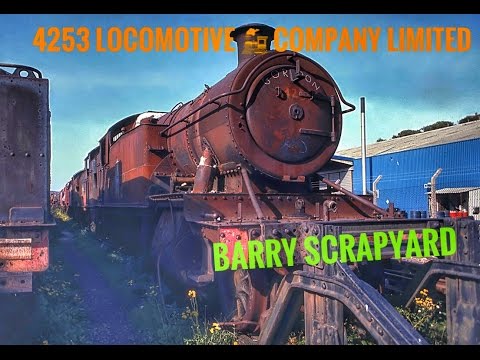
It was withdrawn in 1965 from Shrewsbury and was towed to Woodham Brothersscrapyard in Barry, South Wales.It languished there until 1974 when it was rescued for preservation. It was initially taken to Oswestry for restoration work, but is now based on the Llangollen Railway, a restored part of the Ruabon Barmouth Line, and it has seen regular services on the Llangollen Railway and has been on loan to the West Somerset Railway, Gloucestershire & Warwickshire Railway, South Devon Railway, Keighley and Worth Valley Railway, Great Central Railway (Nottingham) and even The North Yorkshire Moors Railway. 7822 returned to service in early 2016 following heavy boiler repairs and can be seen regularly operating at Llangollen.
One of the endearing features of most preserved railways is the various coaches,wagons and trains to be seen from the train,why your sitting there having your cream tea .or stretching your legs for a walk around Wittersham road.
Inevitably they are in various states of repair. and now thanks to the Rother Valley Railway
the kent and east sussex railway has a large facility .
The building was paid for by The Rother Valley Railway, who are working on laying track towards Bodiam from Robertsbridge to give the a connection from Tenterden with Network Rail.
The carriage storage facility won an award from the Institute of Civil Engineers, partly due to it being built for the relatively small amount of £500,000.
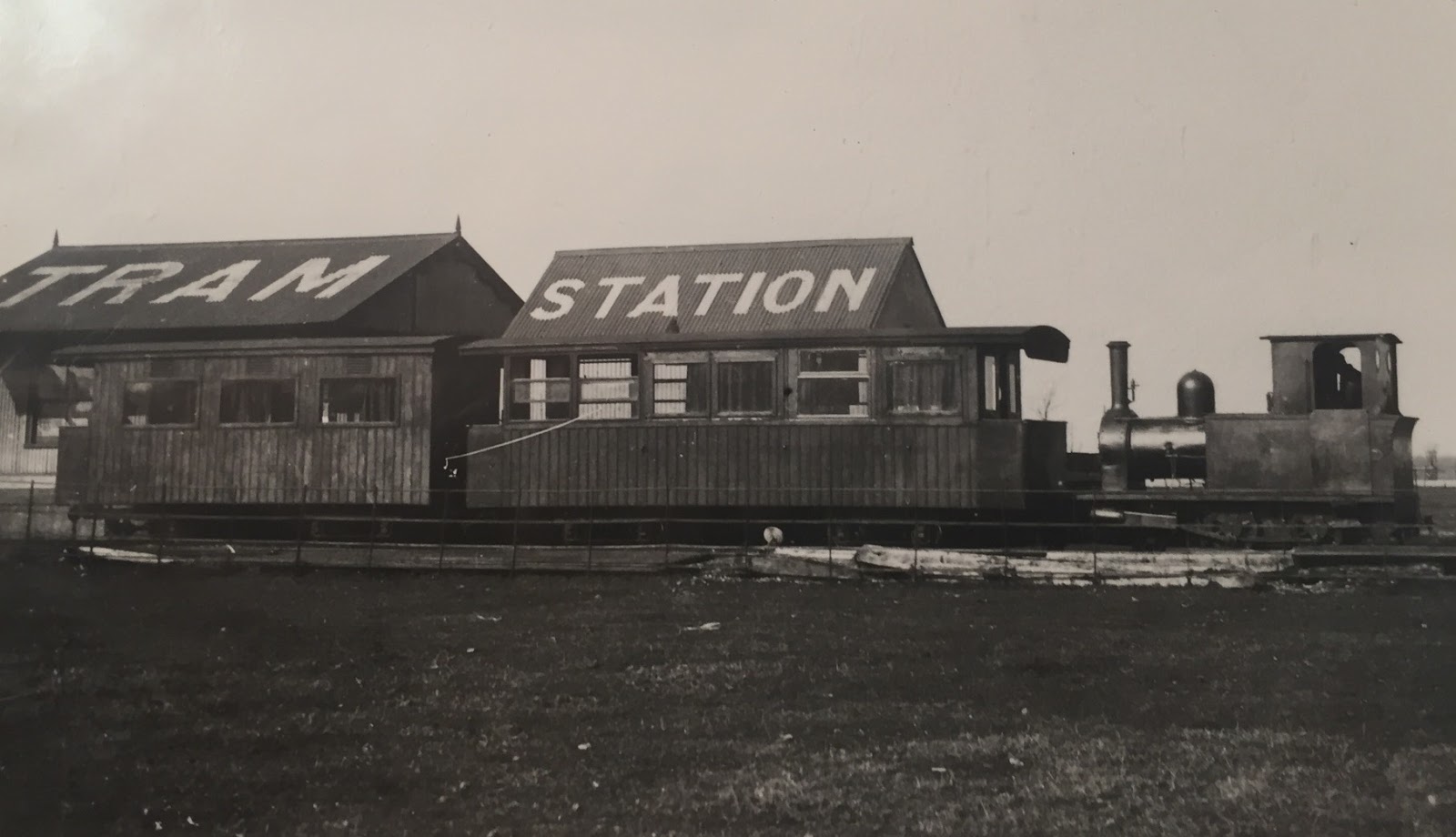
Camber golf links, Rye and Camber Tramway was a railway in East Sussex in 1895 the Rye and Camber Tramway was opened to connect Rye with a new golf course at Camber.
Rye Tramway
Designed to cater for the transportation needs of golfers and their caddies, the steam railway also took fishermen from Rye to their fishing boats moored opposite Rye Harbour village, where a river ferry could be hailed.
Rye (Tramway top right )
The line's promoters cunningly decided to build the line entirely on private land, thereby avoiding the necessity of having to obtain an Act of Parliament.
Built to a 3ft gauge with economy in mind, the 1.75 mile line ran parallel to the River Rother from its Rye terminus as far as Broadwater Beach, before heading across Northpoint beach and terminating opposite Rye Harbour Village
The track was spiked directly to wooden sleepers to save cost, and there was two loops at each end of the line to let the engines run around the coaches.
you tube clip of the tramway
The two termini were both built of corrugated iron and wood, offering a canopy, waiting room and booking office.
With only one engine in steam at any given point, there was no need for signalling.
When it opened on Saturday, 13th July, 1895, the line was equipped with one steam engine and a passenger coach, divided into first and second class compartments.
The engine, named 'Camber' and accompanying carriage were built by W.G.Bagnall Limited of Stafford.
Although capable of better things, the engine normally sauntered around the track at a stately 10mph, pulling a three ton passenger car.
The coach, divided into first and second class sections, was around twenty-six feet long with entrance platforms at each end.
The first class portion could accommodate 12 passengers and came with cushioned seats and curtains, while the cheapskates in second class had to make do with longitudinal strip-wood seating .
Traffic was encouraging, with 18,000 tickets being sold in the first six months, prompting the company to invest in a second, more powerful, steam engine in 1897, patriotically named 'Victoria'.
The company continued to prosper, adding a half mile extension to a deserted location at Camber Sands on 13th July, 1908.
The station was extremely low on facilities, offering nothing more than a raised platform made from old standard gauge sleepers, with a small hut being added later.
Endeavouring to make the most of its remote location, the timetable described the station as being 'far from the madding crowd' and a perfect location for picnics.
With the extension complete, the original Camber terminus was renamed as Golf Links, and the service ramped up in the summer months to 13 trains each way daily, of which only seven ran through to Camber Sands.
A special Saturday late night train ran for golfers at 8:15pm.
In the winter months, the service was cut back to seven trains each way daily, nine trips on Saturdays and four on Sunday, with all trains terminating at the Golf Links station.
Road competition, rising coal prices and high maintenance costs forced economies on the line in the 1920s, with the steam locomotives being replaced by a four wheeled petrol tractor in 1924. The winter service was abandoned completely in 1925-6 and a long period of decline set in.
With the outbreak of war in 1939, the line was closed to the public and used by various military and naval purposes.
Unhappily, the track and rolling stock was in such dreadful condition at the end of the war that the company decided to wind up the railway forever.
Although the Golf Links/Camber station has survived remarkably well for a corrugated iron structure, no trace remains of the Rye terminus or the station at Camber Sands.
St Michaels Tunnel the forgotten relic of the Kent and East Sussex Railway
Add caption
One of his 'bigger' feats was St Michaels Tunnel, located just north of the halt. Opened in 1905 as part of an extension from Tenterden to Headcorn, it is just 31 yards in length and curves to the east on a radius of approximately 30 chains.The portals are neat, brick-built affairs with a masonry string course and copings. Wing walls extend outwards parallel to the track - the east-side wall at the south end is cracked top to bottom. Horseshoe shaped in profile, the lining comprises four rings of brick and features a single refuge. Timber brackets supported telegraph wires.
now a back garden
Despite almost 60 years of redundancy, the structure remains in fair condition except for the cracked wing wall and some spalling of the north portal's headwall. The interior has found function as a wood store, used by the householder whose property it stands on. a train running through the tunnel
Razed to the ground after complete closure by British Railways in 1961, this station has risen from the ashes under the auspices of the preserved ‘’Kent & East Sussex Railway’’ (K&ESR). Wittersham Road originally came into passenger use with the ‘’Rother Valley Railway’’ (RVR) between Robertsbridge and Tenterden on 2nd April 1900, goods traffic having commenced on 29th of the previous month. As mentioned elsewhere on the website, the line was subject to a 1⅓-mile eastward extension to a more conveniently-sited ‘’Tenterden Town’’ station, and was eventually taken as far as Headcorn, where it met the ex-SER Dover trunk line. These extensions came into use on 16th March 1903 and 15th May 1905 respectively, and the RVR became known as the K&ESR from 1904 onwards.
The line was engineered by Holman F. Stephens, and architecture was standardised along the route, a practice which had been followed by numerous of the larger railway companies nationwide. The route was single-track throughout, and in common with most stations on the line, just a single brick-built platform surface was provided at Wittersham Road. The station resided 2¼-miles northwest of the village it purported to serve, hence its ‘’Road’’ suffix, and its construction certainly seemed reminiscent of the old SER policy of providing stations at a ‘’modest cost’’! Wittersham Road’s main building was a typical unassuming H.F. Stephens affair: single-storey, it was fully fabricated from corrugated iron – as per all those structures in-between Robertsbridge and Tenterden Town exclusive – and incorporated sash-style windows. The fact that the building was erected at right angles to the platform seems to explain why it was the only station structure along the entire route to lack a canopy. The very same style of construction could be found on H.F. Stephens’ contemporary Sheppey Light Railway in North Kent, and on those railways he engineered in far flung locations in Shropshire and Wales.
Wittersham Road’s platform was lined at its rear by wire fencing, which in turn was accompanied by rectangular-shaped gas lamps supported upon wooden posts. Behind the platform could be found the station’s goods facilities, which comprised a pair of Tenterden-facing sidings, access to which was controlled from a lever frame positioned north east of the layout. Signalling at the site was primitive, simply comprising a double-armed semaphore post at the Robertsbridge end of the station platform, which resided immediately adjacent to a level crossing. The latter was protected by a pair of timber gates, to which were affixed a red warning diamond, as opposed to the more customary circle. This was not unique to Wittersham Road, a number of other level crossings along the route being similarly treated. It is worth noting that the station lacked a loop, thus it was not possible for trains to pass in the station (unless, in an extreme case, a train service was stabled in the goods yard to let another pass!).
Naturally, the station led a quiet existence on a decidedly rural route, but the monotony was broken as a result of World War II. In February 1941, the goods yard became host to a 32-ton rail-mounted gun, which could fire 9.2-inch diameter shells, and had a range of twenty miles. Thus, in the event of an invasion, the gun’s fire was able to hit the coastline of the Romney Marsh. The gun was not used in anger, although was test fired, and to move the colossus, an ex-GWR 0-6-0 ‘’Dean Goods’’ locomotive, now under ‘’War Department’’ ownership, was provided on the line. The locomotive was also used to move an identical gun based at Rolvenden. To accommodate the gun at Wittersham Road, an ammunition store was erected in the goods yard, as was a gun crew hut. A military presence remained at the station until August 1944.
RVR Rother Valley Railway Restoring the Missing link 2017 Rother Valley Railway KESR to RVR
The Rother Valley Railway (RVR) is a heritage railway project based at Robertsbridge in East Sussex, England. It takes its name from the original name for what later became the Kent and East Sussex Railway, running from Robertsbridge through to Headcorn in Kent, via Tenterden. The project is to replace the ‘missing link’ between Robertsbridge, a station on the Tonbridge to Hastings mainline, and Bodiam on the Kent and East Sussex Railway, a heritage railway which operates from Bodiam to Tenterden. A charity supported by a society of volunteers are attempting to re-establish the railway link. The RVR began by reinstating the first few hundred yards of line eastwards from Robertsbridge, and also a short stretch westwards from Bodiam. In 2010, the latter section was further extended to reach Junction Road. In summer 2011 work began at Robertsbridge to extend further eastwards to Northbridge Street, which entailed the rebuilding of five bridges. By June 2012, this further extension was also completed. In September 2013, a Gala weekend at Robertsbridge marked the progress to date and the start of the next phase - the re-instatement of the section between Northbridge Street and Junction Road, for which statutory permissions are being sought. While the RVR does not yet feature regular passenger trains, the base at Robertsbridge houses a small shop and visitor centre open to the public each Sunday, utilising a building formerly used as the London terminus of the Orient Express. There is also a small collection of historic railway vehicles in various stages of preservation.
Drone footage of RVR
Pictures by https://www.facebook.com/Frame-Me-Ple....
RVR website http://www.rvr.org.uk
KESR website http://www.kesr.org