The next stage of the eagerly awaited Folkestone Seafront redevelopment will see the harbour station renovated. work is now pushing ahead at full steam ..
with no sign of a train in site !!!!!
Work is already being carried out to restore and repair the historic and listed harbour viaduct and swing bridge and the harbour station
The viaduct, which once carried trains into the harbour, will become a new pedestrian walkway for people to walk along the old platforms, down the tracks and onto the Harbour Arm pier.
another development will see the arrival of These historic carriages, which have sat on the Wearside seafront for decades, will house a restaurant at Folkestone harbour’s historic railway station.
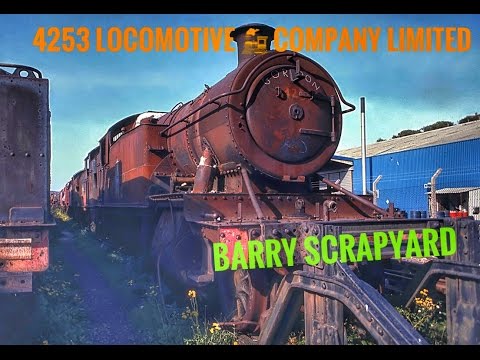
This locomotive, was built at Swindon in 1926 and spent its working life in and around Cardiff Valley hauling both freight and passenger trains. Like many others, 5668 ended up sold to Woodham’s scrap yard at Barry in November 1964 as steam was phased out in favour of diesel. It languished there, slowly losing parts, until rescued and moved to the Pontypool & Blaenavon Railway in 1987. A very similar story to that of GWR 4253.
Towards the end of 2012
The kent and East Sussex Railway offered this locomotive as part of a package deal involving a substantial quantity of parts that were required to progress the restoration of 4253.
The agreement was that The 4253 Locomotive Company Limited would undertake the restoration of 5668 but that no work would commence until such time as 4253 had been completed and returned to steam.
At the 2013 AGM, shareholders voted in favour of proceeding with the deal and suggested an appeal be launched to raise funds to pay for the transportation of the loco from Blaenavon to Rolvenden. In excess of £2.6k was raised and, in late 2013, 5668 was moved to its new home.
Although no restoration work will begin for some years, it is important that the loco does not deteriorate
5668 was moved to Rolvenden yard where it was cleaned up and greased as necessary to provide some protection.
It has now been carefully sheeted and returned to Wittersham Road siding for storage to await its turn to be bought back to life.
As a result of this deal our railway, the Kent & East Sussex, will be assured that yet another powerful steam locomotive will be added to its fleet in due course to haul passenger trains on the extended line from Tenterden to Robertsbridge
Kent and East Sussex Railway and Rother Valley Railway Extension to Udiam Farm from Bodiam
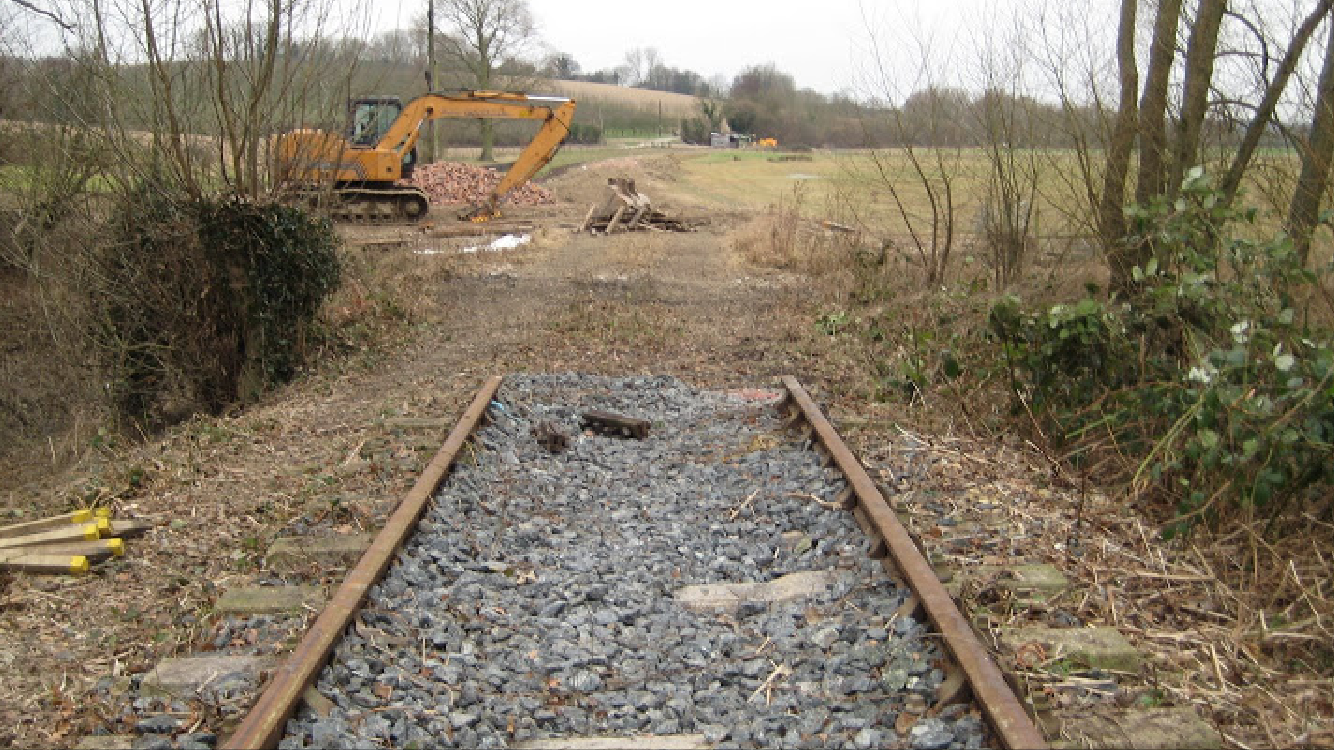
The Rother Valley Railway, a preservation group set up in 1991, had by March 2009 laid track from Bodiam to within 200 yards (180 m) of the site of Junction Road Halt at a cost of £200,000.
Track was relaid through the site of the halt in June 2010.
On 18 March 2011, a VIP dining special was the first passenger train to traverse the rebuilt line.
The following weekend of 19/20 March saw Kent and East Sussex Railway services run as far as Junction Road
It was of 3 ft (914 mm) narrow gauge, relatively unusual amongst British narrow gauge railways. It operated from 1895 until 1939, connecting Rye to the coast. It was about 13⁄4 miles (2.8 km) in length, and had three stations - Rye, Golf Links and Camber Sands. It operated mainly to transport golfers to the golf links and holidaymakers to the coastal dunes.
3⁄4 miles (2.8 km) in length, and had three stations - Rye, Golf Links and Camber Sands. It operated mainly to transport golfers to the golf links and holidaymakers to the coastal dunes. The railway was constructed between January and July 1895 and ran entirely on private land. It was the first designed by consulting engineer Colonel Holman F. Stephens, who went on to build and run small railways all over the Country.
The line was built to convey golfers to the Rye Golf Club and ran from Rye station to the golf club. In 1908 the first extension to Camber Sands station was opened and the intermediate station renamed "Golf Links". Camber terminal was moved to a more accessible site and a tea hut was opened at the end of summer 1938, but this only used for a few months as the war intervened the next year.
Although initially quite successful, increasing competition from automobile and bus transport eventually caused the tramway to enter a gradual economic decline, as was the case with many small railways. Passenger service was ended at the outbreak of World War II but it was extensively used by the Government to convey parts for the P.L.U.T.O. (Pipe Line Under The Ocean) project for which a special siding leading to a new pier near Golf Links Station was constructed by Canadian troops.
The line was in such a run-down a condition by the end of the war that it was deemed irrecoverable and was sold for scrap in 1947. The Rye & Camber Tramways Co. Ltd was liquidated in February 1949. Remains A number of relics, including the frame and bogies of one of the carriages, can be seen at the Colonel Stephens Museum at Tenterden. Golf Links station building survives virtually intact. Some track is embedded in concrete near the station as the trackbed was used as a roadway during wartime. Most of the route is a footpath, although a short section has been destroyed by gravel workings. The line plays a prominent part in several novels by Rye resident E.F. Benson.
The K&ESR owned two Terriers, the first bought in May 1901 and the second in February 1905, becoming No.3 “Bodiam” and No.5 “Rolvenden” respectively. Both were from the initial batch of six engines, four of which eventually came to Stephens’ railways. “Rolvenden”, the former LB&SCR No.71, had the honour of being the first Terrier built. “Bodiam”, although having the first number of the batch as LB&SCR No.70, was actually the last, having bequeathed her cylinders to 71, when a faulty casting had delayed her introduction into service (strange how these sisters were twinned from birth).
from the framemeplease collection
Both engines were painted in Stephens’ favourite blue livery with red lining, but without a polished dome. With regular overhauls, including that of “Bodiam” at Eastleigh in 1919 and “Rolvenden” at Brighton in 1917, they gave excellent service until the depression years.
from the framemeplease collection
They were alike as two peas for much of their lives together even to the near simultaneous acquisition of three rail coal bunker extensions (the LB&SCR extensions had four); the only difference being a long-strapped A1X type door carried by “Rolvenden”, probably acquired at Brighton. Although the two Ilfracombe Goods engines acquired in 1910 and 1914 became the favoured engines, the Terriers were the mainstay of the line in the Edwardian era, and much used thereafter.
Both engines seem to have received their last partial re-tube in late 1928, with “Bodiam” falling into disuse around the time of the railway’s receivership in 1931. (There is photographic evidence of her apparently in steam questionably dated as 12th September in that year.) “Rolvenden” seems to have lasted a little longer. They were then dumped in the works yard but “Bodiam” was resurrected in 1933 and repaired over the next two years, mainly by a Southern Railway fitter at weekends. Although much reported, there is little evidence, apart from anecdotal, to suggest that she incorporated many major parts from her sister, except possibly her tanks.
However some Terrier parts most certainly came from the Shropshire & Montgomery Terriers mentioned below. In the process “Bodiam” acquired her enlarged and distinctive bunker. Re-entering service on 27th December 1934, she was repainted in a bright apple green with yellow lining and, according to Austen’s usual practice, lost her nameplate becoming simply No.3, with the company’s initials appearing on the tank side above the number. Officially withdrawn in 1937, the hulk of “Rolvenden” was finally disposed of by T W Ward in October 1938.
from the framemeplease collection
“Bodiam” was replaced by a hired Terrier when its boiler gave out in September 1940. She was out of use until repaired in February 1943 with an A1X pattern boiler and smokebox. She may also have been fitted at this time with the S&MR’s Dido’s tanks acquired in 1941 (see below). Re-boilering was a difficult job for Rolvenden Works, so two K&ESR fitters undertook the work at St Leonards Shed under wartime’s cooperative arrangements. Finished in April 1943 the engine became to all intents and purposes an A1X, whilst retaining the sandboxes on the front splasher like some earlier Isle of Wight rebuilds. Some reports suggest that she did not return home until 7th March 18944 but this cannot now be verified. Further repairs were carried out at Brighton Works in September 1947 where she was repainted a darker green. After Nationalisation, the
engine was taken into British Railways’ stock and further repaired at Ashford in the second half of 1949; remarkably she was repainted again in apple green with yellow ling but as British Railways No.32670.
From then on she worked on the K&ESR until dieselisation; then working at Newhaven and elsewhere [including Hayling Island] with occasional returns including the last day special. She returned in 1964, to preservation – a true living embodiment of the continuity of the K&ESR – on whose metals she has been present for all but 9 of its 105 years of operation.
Thanks to Colonel Stephens Archives at the Kent and East Sussex Railway
Perched on a hill, the medieval town of Rye is the sort of place you thought existed only in your imagination. Almost suspended in time, Rye’s unhurried atmosphere and enchanting streets draw visitors with their warm welcome. It’s small enough to make you feel at home almost straight away but holds enough secret treasures to entice you to stay much longer.
Even the sea is a little wayward at times The River Rother originally took an easterly course to flow into the sea near what is now New Romney. However, the violent storms in the 13th century (particularly in 1250 and 1287) cut the town off from the sea, destroyed Old Winchelsea and changed the course of the Rother. Then the sea and the river combined in about 1375 to destroy the eastern part of the town and ships began use the current area (the Strand) to unload their cargoes. Two years later the town was sacked and burnt by the French, and it was ordered that the town walls be completed,] as a defence against foreign raiders. it retreated from the town centuries ago, leaving Rye a stranded seaside town.
Comprising a single platform and small corrugated hut, the modest halt at St Michaels was added to the Kent & East Sussex Light Railway in 1912 to serve a small community on the outskirts of Tenterden. Its ticket office - if you could call it that - closed in 1938 and the local infrastructure's decline continued until services were withdrawn on 4th January 1954.
The line was engineered and operated by Colonel H F Stephens. One of his 'bigger' feats was St Michaels Tunnel, located just north of the halt. Opened in 1905 as part of an extension from Tenterden to Headcorn, it is just 31 yards in length and curves to the east on a radius of approximately 30 chains.
The portals are neat, brick-built affairs with a masonry string course and copings. Wing walls extend outwards parallel to the track - the east-side wall at the south end is cracked top to bottom. Horseshoe shaped in profile, the lining comprises four rings of brick and features a single refuge. Timber brackets supported telegraph wires.
Despite 60 years of redundancy, the structure remains in fair condition except for the cracked wing wall and some spalling of the north portal's headwall. The interior has found function as a wood store, used by the householder whose property it stands on.
The Colonel Stephens Railway Museum records the career of Holman Fred Stephens, light railway 🚃
The Colonel Stephens Railway Museum records the career of Holman Fred Stephens, light railway promoter, engineer and manager, his family, his railways and his successors.
The museum is based at Tenterden station on the Kent & East Sussex Railway, which was the quintessential Stephens' light railway and was always the heart of his empire.
The collection began in the 1960s largely through the foresight of Philip Shaw, the Kent and East Sussex Railways Historian, who began putting aside items donated by former employees of the Stephen's empire. W H Austen junior in particular, was a considerable source of material, much of which he had inherited from his father.
Hidden behind the public display is the heart of the research section, the historical papers and undisplayed artifacts dating from about the 1880s occupy 20 steel cabinet filing drawers and some 60 metres of racking.
The photographic archive is considerable, though seldom are we given original negatives. Although never counted, there are probably somewhere between 3,000 and 4,000 photographs, the earliest of which were in the Colonels collection.
One of the endearing features of most preserved railways is the various coaches,wagons and trains to be seen from the train,why your sitting there having your cream tea .or stretching your legs for a walk around Wittersham road.
Inevitably they are in various states of repair. and now thanks to the Rother Valley Railway
the kent and east sussex railway has a large facility .
The building was paid for by The Rother Valley Railway, who are working on laying track towards Bodiam from Robertsbridge to give the a connection from Tenterden with Network Rail.
The carriage storage facility won an award from the Institute of Civil Engineers, partly due to it being built for the relatively small amount of £500,000.