Featured post

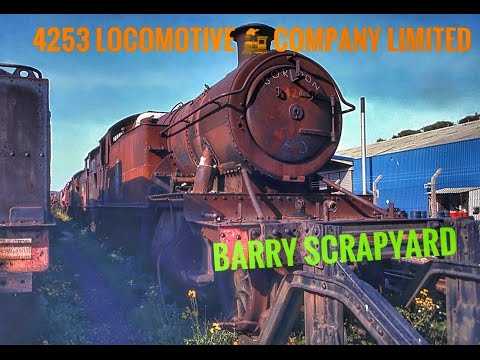
Abandoned and Disused at Barry Scrapyard to the Kent and East Sussex Railway 4253

A Old Abandoned Rusty Train In Barry Scrapyard.  now plan are at thought to rebuild the loco to support the future extension of KES...

Showing posts with label Locomotive. Show all posts

Friday, 28 April 2017

GWR 7800 Class 7822 Fox-cote Manor history behind the guess on the Kent and East Sussex Railway

The Great Western Railway steam locomotive no. 7822 Foxcote Manor is a 4-6-0 Manor Class locomotive, built in 1950 at Swindon Works. It is part of a post-war batch of 10 locomotives, which follows on from 20 earlier locomotives built in 1938.
FOXCOTE MANOR ARRIVING ON THE KESR


The locomotive was originally allocated to Oswestry depot, where it was used to haul both passenger and freight services over lines such as the Cambrian Line and the now-closed Ruabon Barmouth Line. It regularly hauled the "Cambrian Coast Express" from Shrewsbury to Aberystwyth. It was also allocated to Chester shed during its lifespan.


It was withdrawn in 1965 from Shrewsbury and was towed to Woodham Brothers scrapyard in Barry, South Wales.It languished there until 1974 when it was rescued for preservation. It was initially taken to Oswestry for restoration work, but is now based on the Llangollen Railway, a restored part of the Ruabon Barmouth Line, and it has seen regular services on the Llangollen Railway and has been on loan to the West Somerset Railway, Gloucestershire & Warwickshire Railway, South Devon Railway, Keighley and Worth Valley Railway, Great Central Railway (Nottingham) and even The North Yorkshire Moors Railway.


7822 returned to service in early 2016 following heavy boiler repairs and can be seen regularly operating at Llangollen.

Wednesday, 29 March 2017

Ashford railway works . A Disused and Abandoned site in New Town Ashford Kent UK

LATE MARCH 2017

Ashford locomotive works was built by the South Eastern Railway on a new 185-acre (75 ha) site in 1847, replacing an earlier locomotive repair facility at New Cross in London.[1] By 1850 over 130 houses had been built for staff (called Alfred Town by the railway but New Town by everybody else),The works employed about 600 people in 1851 increasing to about 950 by 1861, and around 1,300 by 1882.  A carriage and wagon works was opened on an adjacent 32-acre (13 ha) site in 1850.


South Eastern and Chatham RailwayOn 1 January 1899, the railway entered into a working union with the London Chatham and Dover Railway, forming the South Eastern and Chatham Railway (SECR).[5][6] Each antecedent company had its own locomotive works, but Ashford was larger than Longhedge works and so became the principal locomotive works for the new organisation. The latter facility was gradually run down and converted into a subsidiary works.


Southern Railway and British Railways

Following the grouping of the SECR with the London, Brighton and South Coast Railway and the London and South Western Railway to form the Southern Railway on 1 January 1923, most new locomotive and carriage design and construction was transferred to the more modern facilities at Eastleigh Works. Nevertheless, Ashford continued to operate both building and servicing locomotives and wagons until well after the nationalisation of the railways to form British Railways in 1948.


The locomotive workshops eventually closed on 16 June 1962, the last locomotive to be repaired at Ashford being N class 2-6-0 no. 31400 on 9 June.[9] The wagon works continued for a further two decades[4] producing continental ferry vans, Freightliner vehicles, merry-go-round coal hopper wagons and the Cartic4 articulated car transporter.[10] [8] It became one of BREL's main wagon works, but as trade declined it operated on an ever-decreasing scale until it closed down in 1982

Popular Posts