Featured post

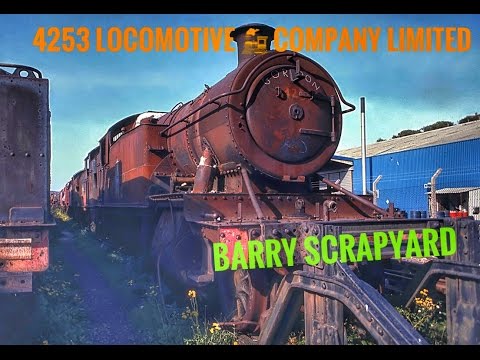
Abandoned and Disused at Barry Scrapyard to the Kent and East Sussex Railway 4253

A Old Abandoned Rusty Train In Barry Scrapyard.  now plan are at thought to rebuild the loco to support the future extension of KES...

Showing posts with label SER. Show all posts

Monday, 24 April 2017

The Abandoned Folkestone Harbour Branch Line, Kent


https://framemeplease19.wixsite.com/trackbedwalker


 The branch line is now officially closed, and has been since 2014. Passenger trains stopped running on this line in 2001 and then to freight and steam trains in 2009. Up until now, the line is starting to be dismantled as Network Rail concluded it is not going to be worth spending millions to get the line up and running again. The old branch line from the South Eastern Main Line at Folkestone Junction served the port of Folkestone and provided a rail connection for boat trains from London which connected with the ferry services to Calais and Boulogne in France.


 At the start of the video, we see the remains of Warren Road Level Crossing, originally an MCB-CCTV level crossing type. Originally, before wigwags came along, this crossing was an MWG type crossing (Manually Worked Gates) with white swing gates and a red circle in the middle. Luckily, Google Maps still have images of the crossing in 2009 when it had NRS Halogen Bulb Wigwags, very old GWE Barriers with Halogen Barrier Boom Lights and intermittent bells. These were taken out between 2012 and 2014, with a fence put in place. All that remains now are red Trespass notices and beware of the live rail, despite the railway being abandoned with no trains for 5 years
https://framemeplease19.wixsite.com/trackbedwalker


Following the line south along the A260, we eventually pass a foot crossing. Pedestrians can still cross here but either side of the pathway are the same fences seen at the Warren Road crossing. The road slowly goes downwards and the railway crosses the harbour. A very unique railway swing bridge is placed right beside the old Folkestone Harbour Station and Level Crossing. It looks to be in the process of being restored as its a grade 2 listed building. Some of the photos here do not belong to me (i.e. ones from Google Maps). These images can be found on the Google Maps street view on Warren Road in Folkestone in May 2009. The remains of the Folkestone Harbour Station and Level Crossing can be seen in a different video taken at night to make it more ere, abandoned and old!
were just cutting the video for the station update 


https://framemeplease19.wixsite.com/trackbedwalker

Booking.com
x

This is a video showing a drive down the abandoned (or more appropriately called "to be dismantled") Folkestone Harbour Branch line from the former Warren Road MCB-CCTV Level Crossing to the end of the branch line at Folkestone Harbour Railway Station. It was recorded in April 2017.


Wednesday, 12 April 2017

Lydd Town station a forgotten relic

Lydd Town Station a forgotten relic
Lydd station today

The Lydd Railway Company (LRC) obtained authorisation to construct a standard gauge single track line from Appeldore to Dungeness with stops ay Lydd and Brookland . the line opened in December 1881


Dungeness station today 


Many Army trains traveled to Lydd , where a private military railway system had a connection onto the main line

This saw the ''Lydd Military Railway'' come into use, which connected the nearby Army Camp with the branch, via the goods yard. As this connection was southward-facing, as per the goods sidings, a reversal manoeuvre was required to proceed from the Army Camp, to Appledore. The Army Camp did provide an interesting traffic of regiment horses in box vans, these quite often being handled at Lydd station itself.

Following the opening of the Romney, Hythe and Dymchurch Railway in 1927, the extra holiday traffic generated persuaded the Southern Railway (who had taken over the line upon the railway grouping) to realign its branch to New Romney by moving it nearer to the sea and opening two new halts 


 Lydd-on-Sea and Greatstone-on-Sea - in 1937. The opening of Lydd-on-Sea Halt led to the renaming of Lydd station as "Lydd Town" to avoid any confusion. 
lydd on sea halt today
The station closed on 6 March 1967 in the face of dwindling passenger traffic and insignificant freight returns, yet the line remained open through Lydd Town as far as a siding near Dungeness for freight traffic to serve the BNFL nuclear power plant at Dungeness.


The future who knows !!
I think it will come down to the outcome of Lydd Airport myself

Booking.com

The video below shows the history of Lydd Station

Initially passenger trains terminated at Lydd. 

The line's promoters hoped that creating a rail link between London and Dungeness would lead to the development of a port from which cross-channel steamers could operate. 

But this grand plan failed to materialise and the branch was left to stagnate. It did though carry some shingle traffic as well as flints for the Potteries .


Monday, 10 April 2017

Lydd on Sea and Dungeness Station Disused and Abandoned

Although the trackbed from Romney Junction towards New Romney is easily traceable, nothing remains of Lydd-on-Sea Halt today except for a gated concrete approach road from Kerton Road .

https://framemeplease19.wixsite.com/trackbedwalker
Promoted  by holiday camp development in the area, the Southern Railway decided in 1937 to realign its branch line to New Romney (which had been opened in 1884) closer to the sea and to open two intermediate stations - Lydd-on-Sea and Greatstone-on-Sea.


 The opening of Lydd-on-Sea on 4 July 1937 coincided with the closure of Dungeness station to passengers 


it was intended that Lydd-on-Sea, ½-mile from Dungeness, would serve both locations and its running in board read "Lydd-on-Sea (for Dungeness)"


To handle the expected flow of holiday traffic, the station was equipped with a long curved island platform with a passing loop on which was perched a small wooden shed.
The traffic never materialised and the station was downgraded to an unstaffed halt on 20 September 1954 when its passing loop was also lifted.
 As passenger traffic dwindled and freight became insignificant, the New Romney branch fell into decline and was listed for closure in the Beeching Report. In 1966 the Minister of Transport Barbara Castle announced her intention of closing the Appledore to New Romney Branch and passenger services ceased on 6 March 1967.
Today (2017)
https://framemeplease19.wixsite.com/trackbedwalker

https://framemeplease19.wixsite.com/trackbedwalker


Booking.com

Wednesday, 29 March 2017

Ashford railway works . A Disused and Abandoned site in New Town Ashford Kent UK

LATE MARCH 2017

Ashford locomotive works was built by the South Eastern Railway on a new 185-acre (75 ha) site in 1847, replacing an earlier locomotive repair facility at New Cross in London.[1] By 1850 over 130 houses had been built for staff (called Alfred Town by the railway but New Town by everybody else),The works employed about 600 people in 1851 increasing to about 950 by 1861, and around 1,300 by 1882.  A carriage and wagon works was opened on an adjacent 32-acre (13 ha) site in 1850.


South Eastern and Chatham RailwayOn 1 January 1899, the railway entered into a working union with the London Chatham and Dover Railway, forming the South Eastern and Chatham Railway (SECR).[5][6] Each antecedent company had its own locomotive works, but Ashford was larger than Longhedge works and so became the principal locomotive works for the new organisation. The latter facility was gradually run down and converted into a subsidiary works.


Southern Railway and British Railways

Following the grouping of the SECR with the London, Brighton and South Coast Railway and the London and South Western Railway to form the Southern Railway on 1 January 1923, most new locomotive and carriage design and construction was transferred to the more modern facilities at Eastleigh Works. Nevertheless, Ashford continued to operate both building and servicing locomotives and wagons until well after the nationalisation of the railways to form British Railways in 1948.


The locomotive workshops eventually closed on 16 June 1962, the last locomotive to be repaired at Ashford being N class 2-6-0 no. 31400 on 9 June.[9] The wagon works continued for a further two decades[4] producing continental ferry vans, Freightliner vehicles, merry-go-round coal hopper wagons and the Cartic4 articulated car transporter.[10] [8] It became one of BREL's main wagon works, but as trade declined it operated on an ever-decreasing scale until it closed down in 1982

Wednesday, 8 March 2017

The Hawkhurst Branch 1892 - 1961 Disused and Abandoned


The Hawkhurst Branch Line was a short railway line in Kent that connected Hawkhurst, Cranbrook, Goudhurst and Horsmonden with the town of Paddock Wood and the South Eastern and Medway Valley lines, a distance of 11 miles 24 chains (18.19 km).

The line was promoted by the Cranbrook and Paddock Wood Railway (C&PWR), which was incorporated in 1877, but took until 1892 to open the first section of the line to Hope Mill. Services were worked by the South Eastern and Chatham Railway (SECR). The line was extended to Hawkhurst in 1893. In 1900, the SECR absorbed the C&PWR. Sunday services ceased in 1917. In 1923, the SECR was absorbed into the Southern Railway at the Grouping. The line became part of British Railways at Nationalisation on 1 January 1948. The line was closed in June 1961, before the Beeching Report was published.
The construction between 1842 and 1853 of the Ashford to Hastings Line, the Tonbridge to Hastings line and South Eastern Main Line between Redhill and Folkestone left a triangle of land within the Kentish High Weald devoid of rail communication. It was a heavily wooded and agricultural area which comprised many small villages and hamlets. The three largest settlements in this area were Cranbrook; the former heart of the defunct Wealden cloth industry, Hawkhurst and Tenterden. There were no large landowners or wealthy industrialists to promote a branch line, while the local railway company - the South Eastern Railway (SER) - preferred to wait until local enterprise had funded the route's construction.


A variety of abortive schemes were proposed, including an 1864 proposal by the nominally independent Weald of Kent Railway to run a route from Paddock Wood to Hythe via Cranbrook for which the SER obtained parliamentary authorisation as a defensive measure against a similar scheme proposed by the rival London, Chatham and Dover Railway. The SER's enthusiasm for the scheme waned after the financial collapse of its rival in the wake of the 1866 Overend Gurney crisis. It was left to another independent company, the locally promoted Cranbrook and Paddock Wood Railway, to revive the scheme in 1877 and pursue it for a further 15 years before its opening in October 1892. The company was incorporated on 2 August 1877.


Construction

The Cranbrook and Paddock Wood Railway obtained authorisation for a single track line to link the two towns from which the company took its name. Agreement had been reached with the SER that it would provide £50,000 towards construction costs once the local company had raised £25,000 in the district. The necessary funds could not be raised and by April 1878 only £11,000 had been found and, on the suggestion of the SER, it was decided to save costs by locating Cranbrook station in Hartley, 2 miles (3.2 km) from Cranbrook's centre, where land prices were higher. Preliminary construction works were commenced in 1879 but soon ground to a halt due to a lack of funds. Undissuaded, the railway company obtained two further Acts of Parliament in 1882 and 1892 which authorised a "cut-price" route between Goudhurst and Hawkhurst.

Friday, 3 March 2017

The engine that brought down a German Bomber , Lydd Station

The engine that brought down a German Bomber , Lydd Station
On 27 November, a train came under attack by two Focke-Wulf 190s. The train, hauled by Southern Railway D3 number 2365 which was just departing from Lydd Town railway station, had its boiler hit. The resulting jet of high pressure steam from the engine hit the plane, causing it to crash-land nearby; the pilot was found dead, but no railway staff or passengers were injured. The two planes had been heading over the coast after a raid on Ashford.


A local newspaper reported that it was the New Romney line’s most famous day when a train brought down an enemy fighter! On 27th November 1942 a train hauled by an ex-LBSCR D3 class locomotive was attacked by a low-flying German fighter aircraft. A cannon shell from the ‘plane burst the D3’s boiler just as the plane flew 20 feet above. The plane crashed, the pilot was killed whilst the train and driver survived! The loco was rebuilt and back in service by 11th March


LYDD TODAY

Monday, 27 February 2017

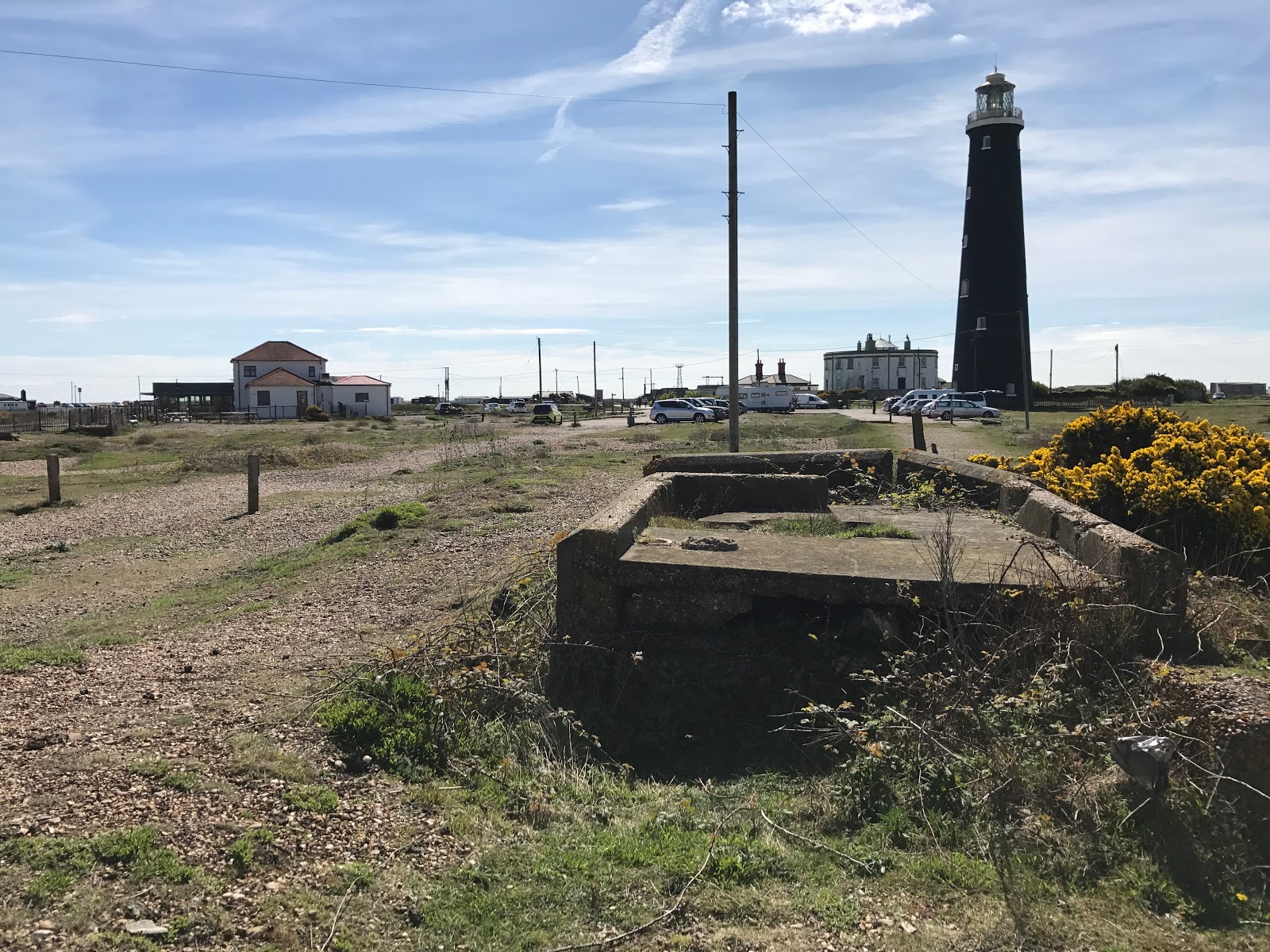
Dungeness (SER) railway station Disused and abandoned


                          Dungeness (SER) railway station Disused and abandoned


Dungeness was the terminus of the Lydd Railway Company's branch from Appledore which opened on 7 December 1881. Passenger services initially terminated at Lydd, although a goods service operated as far as Dungeness. 


Opened to passengers on the 1st April 1883, the single platform terminus at Dungeness lay at the end of a branch line from the South Eastern Railway's station at Appledore. 


Dungeness railway station, 1905 


Built by the Lydd Railway Company, the service was provided by the South Eastern Railway who eventually absorbed the smaller company in 1895. 


The eight mile branch had no less than 12 level crossings, with stations at Appledore, Brookland Halt, Lydd Town, (Lydd-on-Sea Halt and Greatstone-on-Sea Halt from 4 July 1937) and New Romney & Littlestone-on-Sea and Dungeness. 

https://framemeplease19.wixsite.com/trackbedwalker
A large army camp and military ranges at Lydd kept the line busy until the end of WW1, but by the 1920's Dungeness was served by just three trains a day, while New Romney station enjoyed 9 trains a day. 
https://framemeplease19.wixsite.com/trackbedwalker


A realignment of the line along the coast to New Romney in 1937, saw passenger services being withdrawn from Dungeness on the 4th July, 1937

The growing popularity of driving a car saw passenger numbers rapidly decline along the rest of the line in the 1950s, with the Dungeness freight service being withdrawn in 1952. 

Work on the Dungeness Nuclear Power Station in the early Sixties brought a new, albeit brief, lease of life to the line, with two-car diesel-electric trains providing 11 trains a day in 1962, most running through to Ashford. 

Proposed for closure in the infamous Beeching Report of 1963, passenger services managed to cling on to life until the 6th March 1967, with goods services to New Romney already being withdrawn three years earlier. 


Goods services to Lydd continued until 1971, with the line remaining in use for the removal of ballast aggregates and waste from Dungeness B nuclear power station. 


All track beyond Romney Junction has now been lifted with the remaining track only seeing very occasional troop trains and railtours. 
https://framemeplease19.wixsite.com/trackbedwalker


Popular Posts